TABLE OF CONTENT
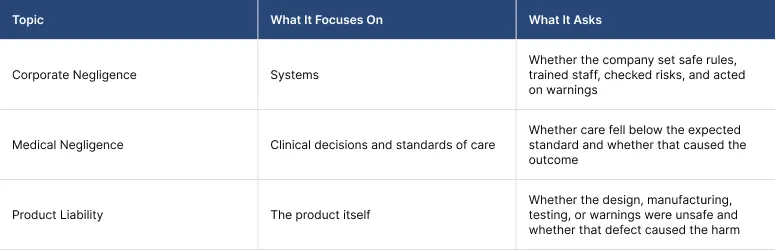
How do you prove a powerful company caused a fatal accident? In wrongful death cases, families not only have to grieve for their loved one, but they have to deal with big companies that deny any wrongdoing.
These cases are often complex. NHS Resolution recorded 1,101 fatal medical negligence claims in 2023. This shows that clinical negligence can be fatal. That’s where expert witnesses make the difference.
Expert witnesses give unbiased and specialised opinions in cases. Their role is to turn complex arguments in a wrongful death case into clear and simple evidence that courts can rely on. In cases of fatal accident claims, expert witnesses can explain issues like cause of death, product related liabilities and compensation.
A wrongful death expert witness helps establish fault and calculate damages. They could be a doctor or an equivalent medical professional, like a podiatrist. Their opinion helps the court understand why it happened and who failed in their legal duty.
Understanding Corporate Negligence in UK Law
Corporate negligence occurs when an entity fails to fulfil its duty of care, resulting in harm or death. Duty of care can come from:
- Common law negligence principles.
- The Health and Safety at Work etc. Act 1974.
- Industry-specific regulations.
- Consumer protection and safety law.
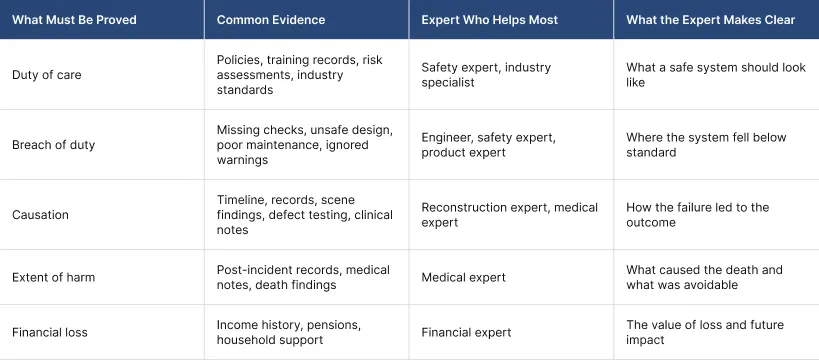
In corporate negligence cases, the claimant must prove:
- The company owed a duty of care.
- It failed to uphold that duty.
- The breach of duty caused harm or death.
- The harm could be foreseen.
Without an expert witness, such cases rarely succeed.
A Simple Proof Framework That Keeps The Case Clear
- Duty means what the company should have done to keep people safe.
- Breach means where the company fell short, like unsafe systems, poor training, poor checks or ignored risks.
- Causation means showing the failure led to the injury or death, not just that a risk existed.
- Harm means the injury, loss or death that followed.
- Foreseeability means the risk was not random. A careful company should have seen it and acted earlier.
Why Expert Witnesses Are Crucial in Proving Wrongful Death?
Courts rely on evidence to make decisions. In cases involving wrongful death, the evidence is often complex. Expert witnesses help the court understand it and decide what went wrong. Their evidence can also affect product related liabilities, damages and compensation.
In wrongful death cases, this can affect the outcome. Expert evidence can shape damages, product related liabilities and compensation.
How Different Types of Expert Witnesses Prove Corporate Negligence?
There are many different types of experts that may be called upon as witnesses. It all depends on the technicalities involved in a case. In wrongful death cases, some common types of expert witnesses are below.
1. Medical Negligence Expert Witnesses
A medical negligence expert witness is required in cases where death or injury come to pass as a result of healthcare decisions. They are often doctors or other qualified healthcare professionals. Their role is to:
- Assess whether the standard of care was followed.
- Check for misdiagnosis or delay in treatment.
- Check whether the death was avoidable.
- Confirm whether the duty of care was breached.
- Link the cause of death to substandard care.
Their opinion is very important in wrongful death cases. It is often the key to linking causation.
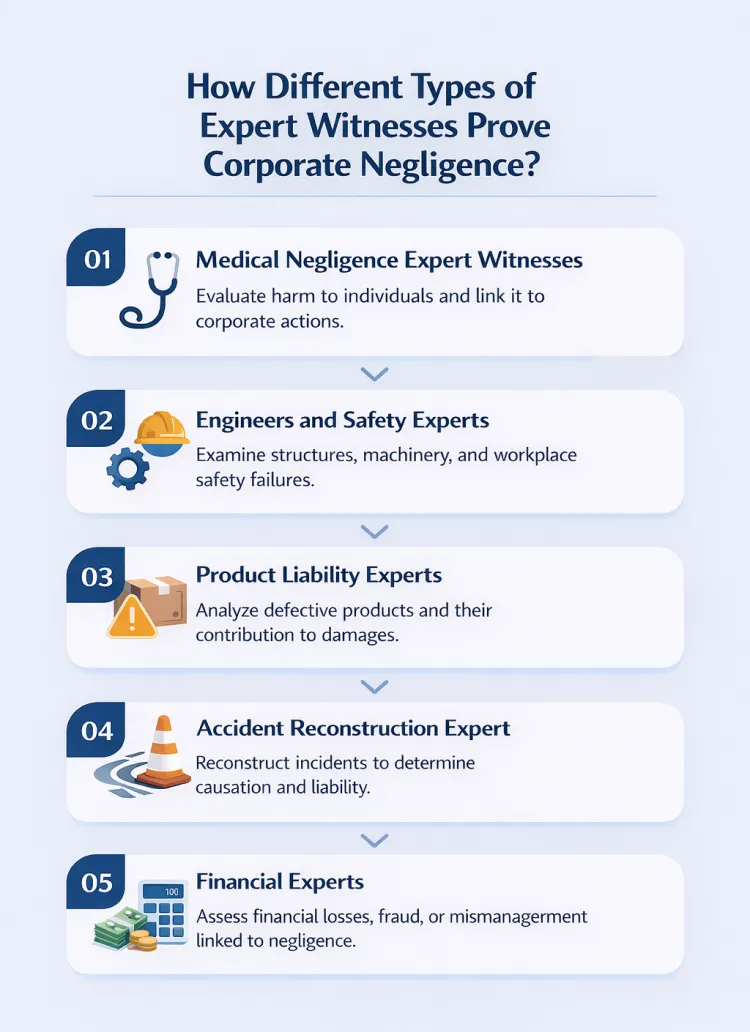
2. Engineers and Safety Experts
In cases of industrial accidents, a safety expert or engineer makes an expert witness. They examine.
- Machinery and equipment maintenance.
- Health regulations.
- Risk and safety measures.
- Structural flaws.
Based on these, they gather evidence to establish if the accident was avoidable or not. Their opinion can show if a company ignored safety measures, which led to wrongful death. A company can be liable if it didn’t follow safety protocols. Such insights are decisive when it comes to wrongful death cases.
3. Product Liability Experts
In cases where products cause harm, product liability experts are called. These expert witnesses deduce how the product caused damage and what flaws resulted in harm or death. They review:
- Product design flaws.
- Manufacturing errors.
- Compliance with UK safety laws.
- Not enough warnings.
- Quality control.
Cases that have product related liabilities can be difficult, as the insurance covers defence for these liabilities for most companies. Expert witnesses can provide data that can establish causation. Their evidence can help show the product was faulty when it entered the market.
4. Accident Reconstruction Expert
In large accidents, the accident reconstruction experts are called in. These are experts in linking causation through forensic techniques. From the evidence, they can deduce the sequence of events that led to fatality. They analyse:
- CCTV footage.
- Physical damage report.
- Site measurements.
Their analysis helps prove how the corporate system failed in its duty. This is crucial for cases of fatal accident claims that have many parties.
5. Financial Experts
Once the fault is proved, the court must decide compensation.
Financial experts can calculate it by taking into account:
- Lost income.
- Pensions and benefits.
- Lost financial support.
- Value of the services the deceased provided.
Financial experts provide accurate data so that courts can provide fair compensation to the affected families.
The Role of Product Liability Insurance Evidence
Large companies use insurance for product related liabilities to cover their defence. This is so if they sell risky products. An expert witness reviews such material to find:
- Safety concerns.
- History of claims.
- Risk warnings.
- Ignored safety advice.
In case of wrongful death, such evidence can prove that the company knew about the risks but still did nothing.
Expert Witness Rules in the UK
An expert witness must follow strict rules under UK law. This is because of the importance of their opinion. Their unbiased assessment holds a lot of weight and thus must be strictly scrutinised.
An expert witness in UK must:
- Be impartial.
- Be qualified.
- Follow CPR-35 and CrimPR guidelines.
- Back evidence with sound reasons.
- Disclose limitations.
Being unbiased is critical to the role of an expert witness. If an opinion is biased, the court may discard it.
What Makes An Expert Report Strong
A strong expert report is easy to follow and easy to test. It sets out what the expert was asked, what materials were reviewed and what facts were relied on. It explains the method used and why the view makes sense. It also states limits clearly, like missing records, unclear timings or more than one possible cause.
A report that is clear, balanced and properly reasoned is harder to dismiss in a wrongful death case.
Why Do Companies Fear Expert Witnesses?
Companies spend lots of effort to discredit expert evidence. This is due to the high-value nature of wrongful death cases. They use tactics like:
- Attacking qualifications.
- Claiming bias.
- Questioning methods.
- Hiring their own experts.
Experts must be prepared for such measures. Their opinion must be clear, logical and well-supported.
How Expert Witnesses Change the Case?
Strong expert evidence may lead to early settlements. When negligence becomes clearer, some companies choose to settle rather than continue. An expert witness can:
- Force companies to settle early.
- Get better compensation.
- Save time and money.
- Strengthen the position of the affected.
In many cases of wrongful death, expert opinion can be what convinces parties to settle early.
To learn more about the role of expert witnesses in cases, check out our blog on how expert witnesses strengthen legal cases.
Why Do Expert Witnesses Matter So Much?
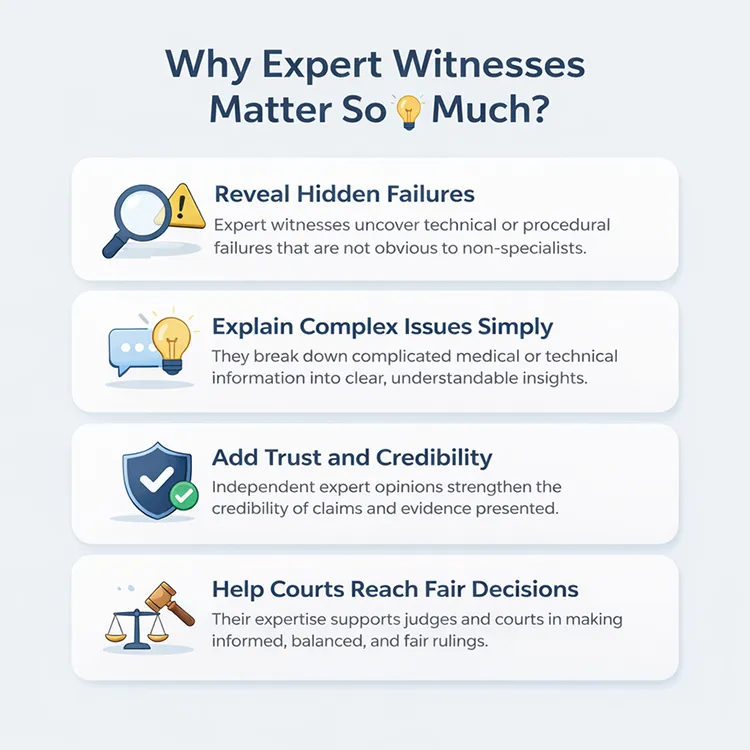
Corporate negligence in injury or wrongful death cases is rarely obvious. It is often hidden behind rules, paperwork and the full weight of the corporate world. Expert witnesses:
- Reveal hidden failures.
- Explain complex issues simply.
- Add trust and credibility.
- Help courts reach fair decisions.
In a wrongful death case, expert witnesses are not optional. They are essential.
Conclusion
When corporate mistakes lead to death, the families deserve answers and justice. Expert witnesses help make that possible. At Concise Medico, we provide all expert witness services that see justice delivered to you.
From expert witnesses to product safety and financial specialists, their role is vital in proving fault and loss in a wrongful death case. Contact us today to turn confusion into clarity and ensure companies are held accountable.
FAQs
How do you prove a powerful company caused a fatal accident? In wrongful death cases, families not only have to grieve for their loved one, but they have to deal with big companies that deny any wrongdoing.
These cases are often complex. NHS Resolution recorded 1,101 fatal medical negligence claims in 2023. This shows that clinical negligence can be fatal. That’s where expert witnesses make the difference.
Expert witnesses give unbiased and specialised opinions in cases. Their role is to turn complex arguments in a wrongful death case into clear and simple evidence that courts can rely on. In cases of fatal accident claims, expert witnesses can explain issues like cause of death, product related liabilities and compensation.
A wrongful death expert witness helps establish fault and calculate damages. They could be a doctor or an equivalent medical professional, like a podiatrist. Their opinion helps the court understand why it happened and who failed in their legal duty.
Understanding Corporate Negligence in UK Law
Corporate negligence occurs when an entity fails to fulfil its duty of care, resulting in harm or death. Duty of care can come from:
- Common law negligence principles.
- The Health and Safety at Work etc. Act 1974.
- Industry-specific regulations.
- Consumer protection and safety law.
In corporate negligence cases, the claimant must prove:
- The company owed a duty of care.
- It failed to uphold that duty.
- The breach of duty caused harm or death.
- The harm could be foreseen.
Without an expert witness, such cases rarely succeed.
A Simple Proof Framework That Keeps The Case Clear
- Duty means what the company should have done to keep people safe.
- Breach means where the company fell short, like unsafe systems, poor training, poor checks or ignored risks.
- Causation means showing the failure led to the injury or death, not just that a risk existed.
- Harm means the injury, loss or death that followed.
- Foreseeability means the risk was not random. A careful company should have seen it and acted earlier.
Why Expert Witnesses Are Crucial in Proving Wrongful Death?
Courts rely on evidence to make decisions. In cases involving wrongful death, the evidence is often complex. Expert witnesses help the court understand it and decide what went wrong. Their evidence can also affect product related liabilities, damages and compensation.
In wrongful death cases, this can affect the outcome. Expert evidence can shape damages, product related liabilities and compensation.
How Different Types of Expert Witnesses Prove Corporate Negligence?
There are many different types of experts that may be called upon as witnesses. It all depends on the technicalities involved in a case. In wrongful death cases, some common types of expert witnesses are below.
1. Medical Negligence Expert Witnesses
A medical negligence expert witness is required in cases where death or injury come to pass as a result of healthcare decisions. They are often doctors or other qualified healthcare professionals. Their role is to:
- Assess whether the standard of care was followed.
- Check for misdiagnosis or delay in treatment.
- Check whether the death was avoidable.
- Confirm whether the duty of care was breached.
- Link the cause of death to substandard care.
Their opinion is very important in wrongful death cases. It is often the key to linking causation.
2. Engineers and Safety Experts
In cases of industrial accidents, a safety expert or engineer makes an expert witness. They examine.
- Machinery and equipment maintenance.
- Health regulations.
- Risk and safety measures.
- Structural flaws.
Based on these, they gather evidence to establish if the accident was avoidable or not. Their opinion can show if a company ignored safety measures, which led to wrongful death. A company can be liable if it didn’t follow safety protocols. Such insights are decisive when it comes to wrongful death cases.
3. Product Liability Experts
In cases where products cause harm, product liability experts are called. These expert witnesses deduce how the product caused damage and what flaws resulted in harm or death. They review:
- Product design flaws.
- Manufacturing errors.
- Compliance with UK safety laws.
- Not enough warnings.
- Quality control.
Cases that have product related liabilities can be difficult, as the insurance covers defence for these liabilities for most companies. Expert witnesses can provide data that can establish causation. Their evidence can help show the product was faulty when it entered the market.
4. Accident Reconstruction Expert
In large accidents, the accident reconstruction experts are called in. These are experts in linking causation through forensic techniques. From the evidence, they can deduce the sequence of events that led to fatality. They analyse:
- CCTV footage.
- Physical damage report.
- Site measurements.
Their analysis helps prove how the corporate system failed in its duty. This is crucial for cases of fatal accident claims that have many parties.
5. Financial Experts
Once the fault is proved, the court must decide compensation.
Financial experts can calculate it by taking into account:
- Lost income.
- Pensions and benefits.
- Lost financial support.
- Value of the services the deceased provided.
Financial experts provide accurate data so that courts can provide fair compensation to the affected families.
The Role of Product Liability Insurance Evidence
Large companies use insurance for product related liabilities to cover their defence. This is so if they sell risky products. An expert witness reviews such material to find:
- Safety concerns.
- History of claims.
- Risk warnings.
- Ignored safety advice.
In case of wrongful death, such evidence can prove that the company knew about the risks but still did nothing.
Expert Witness Rules in the UK
An expert witness must follow strict rules under UK law. This is because of the importance of their opinion. Their unbiased assessment holds a lot of weight and thus must be strictly scrutinised.
An expert witness in UK must:
- Be impartial.
- Be qualified.
- Follow CPR-35 and CrimPR guidelines.
- Back evidence with sound reasons.
- Disclose limitations.
Being unbiased is critical to the role of an expert witness. If an opinion is biased, the court may discard it.
What Makes An Expert Report Strong
A strong expert report is easy to follow and easy to test. It sets out what the expert was asked, what materials were reviewed and what facts were relied on. It explains the method used and why the view makes sense. It also states limits clearly, like missing records, unclear timings or more than one possible cause.
A report that is clear, balanced and properly reasoned is harder to dismiss in a wrongful death case.
Why Do Companies Fear Expert Witnesses?
Companies spend lots of effort to discredit expert evidence. This is due to the high-value nature of wrongful death cases. They use tactics like:
- Attacking qualifications.
- Claiming bias.
- Questioning methods.
- Hiring their own experts.
Experts must be prepared for such measures. Their opinion must be clear, logical and well-supported.
How Expert Witnesses Change the Case?
Strong expert evidence may lead to early settlements. When negligence becomes clearer, some companies choose to settle rather than continue. An expert witness can:
- Force companies to settle early.
- Get better compensation.
- Save time and money.
- Strengthen the position of the affected.
In many cases of wrongful death, expert opinion can be what convinces parties to settle early.
To learn more about the role of expert witnesses in cases, check out our blog on how expert witnesses strengthen legal cases.
Why Do Expert Witnesses Matter So Much?
Corporate negligence in injury or wrongful death cases is rarely obvious. It is often hidden behind rules, paperwork and the full weight of the corporate world. Expert witnesses:
- Reveal hidden failures.
- Explain complex issues simply.
- Add trust and credibility.
- Help courts reach fair decisions.
In a wrongful death case, expert witnesses are not optional. They are essential.
Conclusion
When corporate mistakes lead to death, the families deserve answers and justice. Expert witnesses help make that possible. At Concise Medico, we provide all expert witness services that see justice delivered to you.
From expert witnesses to product safety and financial specialists, their role is vital in proving fault and loss in a wrongful death case. Contact us today to turn confusion into clarity and ensure companies are held accountable.