Functional Neurological Disorder in Personal Injury Claims

Published On: June 22nd, 2026|Total Views: 2|Daily Views: 2|16.9 min read|3384 words|

Not every serious injury appears on a scan. A serious road accident, fall or slip may lead to problems with movement, speech, memory, balance or seizure-like episodes, even when MRI and CT scans look normal. This is often the reality for people living with functional neurological disorder (FND).

FND is a recognised neurological condition that affects many people across the UK. According to research, an estimated 50,000 to 100,000 people in the UK are living with FND.

FND is one of the most misunderstood conditions in personal injury claims. The symptoms can be serious and life-changing, yet medical tests may show no clear damage. This makes the condition hard to explain. It can also make a functional neurological disorder claim more difficult.

Some people with FND face doubt from employers, insurers, doctors and even family members. This can feel painful and unfair. The symptoms are real. The impact is real. The financial loss can also be very real, which is why a functional neurological disorder claim may be important for those affected.

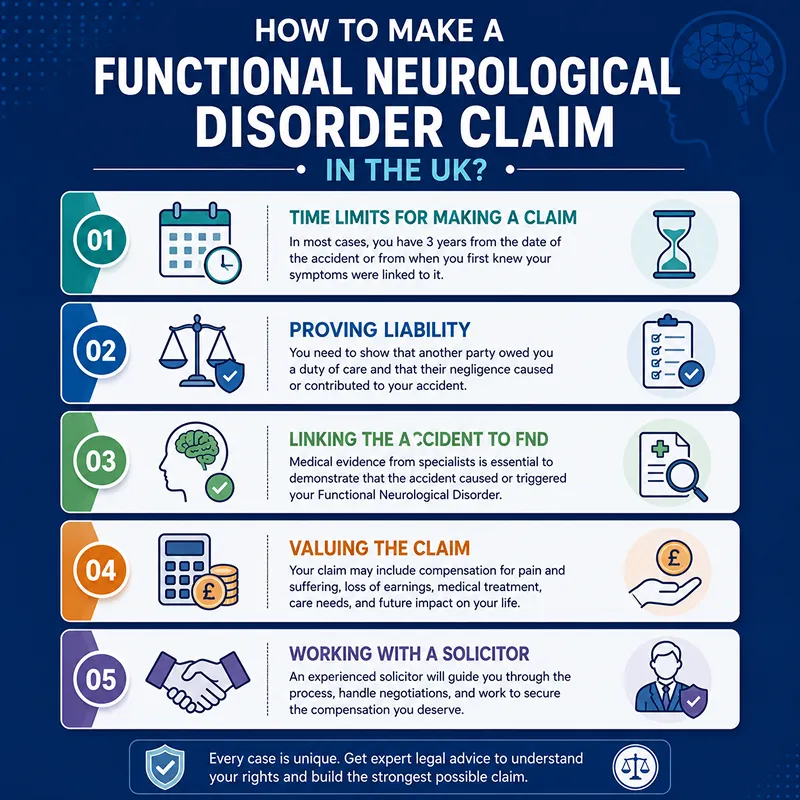
When FND develops after an accident caused by someone else’s negligence, important legal questions arise. Did the accident cause the condition? Did it trigger symptoms in someone who was already vulnerable? How can someone prove symptoms when scans appear normal? What compensation can be claimed? These questions matter in functional neurological disorder claims.

Understanding FND, how doctors diagnose it, how functional neurological disorder claims work and how the condition affects personal injury litigation can help claimants take the right steps after an accident.

 Key Takeaways

  • A functional neurological disorder claim can arise when FND is caused, triggered or worsened by an accident linked to someone else’s negligence
  • FND symptoms are real and can affect movement, memory, speech, balance and daily activities even when MRI and CT scans appear normal
  • Early diagnosis and timely rehabilitation can improve recovery outcomes and may strengthen a functional neurological disorder compensation claim
  • Medical records, witness statements and specialist expert evidence are often essential to prove causation and support a functional neurological disorder court claim
  • Compensation may cover pain and suffering, loss of earnings, treatment costs, care costs, travel expenses and future financial losses
  • Prognosis plays a major role in valuing a claim because long-term symptoms can increase future care, rehabilitation and support needs
  • Working with experienced medico-legal experts can help ensure a functional neurological disorder claim is supported by the right evidence and specialist opinions

What Is Functional Neurological Disorder?

Functional neurological disorder is a condition that affects how the brain and nervous system send and receive signals.

Unlike a stroke or multiple sclerosis, FND does not usually cause visible damage to the structure of the brain. The problem is with how the nervous system functions.

Many specialists explain it in a simple way. The brain’s hardware is intact but the software is not working as it should. A person can still experience real neurological symptoms even when scans and tests look normal. That can affect daily life in a serious way.

In the past, FND was often called hysteria or conversion disorder. Today, doctors understand FND as a complex condition that sits between neurology and psychiatry.

This is why a functional neurological disorder claim often needs clear medical evidence from the start.

1. What Are the Common Symptoms of FND?

FND symptoms can look different from person to person. For some people, symptoms stay mild. For others, they affect work, independence and everyday life. Following are the common symptoms of FND:

Important:

Even a short delay can affect cancer treatment options. As cancer progresses, it may spread to nearby tissues or other parts of the body, making treatment more complex and reducing the chances of a successful outcome.

  • Functional limb weakness is common. A person may feel weakness in an arm or leg even when doctors cannot find structural nerve damage.
  • Functional movement disorders may cause tremors, spasms, jerking movements or unusual walking patterns.
  • Functional tremor can cause shaking in the hands, arms, legs, neck or body.
  • Functional gait disorder affects walking. A person may struggle with balance, coordination and mobility.
  • Functional sensory symptoms may include numbness, pins and needles, reduced feeling or altered sensation in parts of the body.
  • Some people experience functional seizures. These are also called dissociative seizures or non-epileptic attacks. They may look like epileptic seizures but they are caused by different processes in the nervous system.
  • Cognitive symptoms are also common. Many people report brain fog, poor memory, poor concentration and difficulty processing information.
  • Speech may also be affected. Some people develop stuttering, slurred speech or difficulty finding words.
  • Some people also experience visual symptoms, hearing problems or swallowing issues.
  • Many people with FND also have fatigue, headaches, chronic pain, poor sleep, anxiety and low mood.

2. Can Other Health Conditions Cause Similar Symptoms?

Yes, other health conditions can sometimes cause similar symptoms. This does not mean the person is lying. It only means doctors must check the diagnosis carefully.

Some people may have FND and another brain or nerve condition at the same time. Others may also have anxiety, depression, post-traumatic stress disorder (PTSD) or long-term pain.

In rare cases, doctors may also consider ‘Illness Anxiety Disorder’ or ‘Factitious Disorder’. The goal is not to ignore the symptoms. The goal is to find the correct diagnosis. This matters because the diagnosis can affect the claim, treatment and compensation.

3. Why Are FND Symptoms Often Misunderstood?

One major reason is that symptoms can change. A person may manage quite well one day and struggle badly the next day. Sometimes symptoms change within the same day. Someone may walk without help in the morning but need support later because of fatigue, weakness or pain. This can confuse people around them.

An employer may not understand why a person can do a task one day but not the next. A family member may feel unsure what is happening. An insurer may wrongly think changing symptoms mean the condition is exaggerated.

Fluctuation is a known feature of FND. The fact that symptoms change does not mean they are false.

Some symptoms may also improve for a short time when attention is moved elsewhere. This can seem strange but doctors who understand FND know how to assess these signs properly.

This is why specialist medical evidence is so important in functional neurological disorder claims.

4. What Causes Functional Neurological Disorder?

FND does not have one clear cause. Doctors believe it can happen because of many different things working together. These may include stress, trauma, mental health problems, neurological conditions, illness or physical injury. In some people, an accident or traumatic event can trigger FND symptoms.

Doctors sometimes explain FND with three simple factors, such as:

  • Predisposing factors: These are things that may make a person more likely to develop FND. These can include past trauma, long-term stress, anxiety, depression or difficult life events
  • Precipitating factors: These are things that start the symptoms. These may include an accident, injury, illness, surgery or a traumatic event
  • Perpetuating factors: These are things that keep symptoms going. These may include stress, fear of symptoms, less activity, emotional difficulties or the stress of a legal claim

Not everyone with FND has a clear mental health trigger. Some people develop FND after a physical injury with no past trauma or mental health issue. This is why doctors must look at each case carefully.

Can a Minor Accident Trigger FND?

Yes, in some cases. The cost of future care is an important point in personal injury claims. Defendants and insurers may argue that a minor accident could not cause serious symptoms. However, the severity of the accident does not always match the severity of FND symptoms.

A person may leave a low-impact accident and later develop serious functional symptoms. This does not mean the symptoms are not real.

FND appears to involve how the nervous system responds to the event. It is not only about the level of physical damage. This is one reason why causation is often disputed in functional neurological disorder claims.

How Is FND Diagnosed?

FND is usually diagnosed by a neurologist who understands the condition. The doctor will review the person’s medical history, symptoms, examination findings and test results. Doctors also look at triggers and symptom changes that hints towards FND.

There is no single blood test, brain scan or investigation that confirms FND. MRI and CT scans are often normal.

Some clinical signs may support the diagnosis. For example, functional weakness may show patterns that are different from weakness caused by structural neurological disease.

The diagnosis must still be careful. The symptoms should not be the result of another neurological or mental health condition.

At the same time, FND can exist with other conditions. A person may have FND and a brain injury. A person may have FND and chronic pain. A person may have FND and depression. This makes proper assessment very important. A clear diagnosis can also help support a functional neurological disorder claim by showing what condition is present.

FND vs Structural Neurological Conditions

Why Does Early Diagnosis Matter?

Early diagnosis matters because it can stop people from getting treatment they do not need. Some people with FND have many tests before doctors find the right diagnosis. This can slow down recovery.

When doctors diagnose FND early, treatment and rehabilitation can start sooner. Many people do better when they get help early.

A clear diagnosis also helps the person understand what is happening to their body. For many people, this feels like the first step towards recovery.

Early Action Matters:

Early diagnosis and rehabilitation can improve recovery outcomes in FND.

Sadly, some doctors and clinics still do not understand FND well. This means many people wait too long for the right diagnosis.

How Does FND Affect A Personal Injury Claim?

FND can make a personal injury claim more complex because the symptoms are often serious but standard medical tests may appear normal.

A broken bone may appear on an X-ray. A spinal injury may appear on an MRI scan. FND is different. Symptoms may be severe but standard tests may appear normal. This can lead to doubt from insurers and defendants. One key question is whether the accident caused the FND.

In some cases, symptoms begin soon after the accident. In others, they appear weeks or months later. This delay can create arguments about causation.

A defendant may say the symptoms are not linked to the accident. They may argue that another factor caused them. They may also say the claimant was already vulnerable and would have developed FND anyway. This is why strong medical evidence is needed to support a functional neurological disorder claim.

What Evidence Helps Prove a Functional Neurological Disorder Claim?

Medical records are a good place to start when proving a functional neurological disorder claim. These records show the person’s health before and after the accident. GP notes, hospital records, physio records and mental health records may all help.

Doctors will check if there were any FND symptoms before the accident. If the symptoms only started after the accident, this may support the functional neurological disorder claim.

Witness statements can also help. Family members may explain how FND affects the person every day. Friends, workmates and carers can also share what they have seen.

Work records may show time off, lower pay or changes in job duties. Care records may show what help the person now needs. All this evidence helps show how life changed after the accident.

Why Are Expert Witnesses So Important in a Functional Neurological Disorder Claim?

Functional neurological disorder claims often need expert doctors because FND can be hard to understand. It is linked to both the brain and mental health, so a normal doctor may not have enough specialist knowledge to explain it fully.

A neurologist can help confirm the FND diagnosis. They can also check if another nerve or brain condition is causing the symptoms.

A psychiatrist or neuropsychiatrist can look at stress, trauma, mental health and recovery chances.

A psychologist can explain what treatment may help and how the symptoms affect daily life.

Other experts may also help. These can include pain experts, care experts, work experts and occupational therapists.

All experts should work together. This helps give a clear picture of the claimant’s condition, needs and future support.

Can People With FND Be Wrongly Accused of Exaggerating Symptoms?

Yes, this can happen in a functional neurological disorder claim. FND symptoms can change from day to day. A person may look better one day and worse the next. This does not mean they are lying.

Malingering is different from FND. Malingering means a person knowingly makes up or exaggerates symptoms for money or personal gain.

FND is not malingering. People with FND have real symptoms, even when medical tests look normal. However, the condition is still poorly understood and some claimants may be accused of exaggerating. This can be very upsetting for them.

Key Point:

Consistent medical evidence is often crucial in FND claims.

If a court finds fundamental dishonesty, the claim may be dismissed. This is why strong evidence matters. Medical records, witness statements and expert reports should support the claimant’s account.

Can Surveillance Evidence Be Used in a Functional Neurological Disorder Claim?

In some functional neurological disorder claims, defendants may use surveillance. This means someone may record what the claimant does in daily life. They may compare this with what the claimant has said about their symptoms.

This can be tricky in FND cases because symptoms can change. A short video may only show one small part of the day. A person may walk normally for a short time. Later, they may struggle with tiredness, weakness or pain. This does not always mean the person is exaggerating.

Surveillance evidence should be checked with the full medical evidence and the nature of FND.

What Treatment and Rehabilitation Options Are Available for FND?

Many people with FND can get better with early care. Treatment works best when different experts work together.

  • Cognitive Behavioural Therapy (CBT): Helps people understand thoughts, feelings and symptoms
  • Physiotherapy: Helps with weakness, movement and walking
  • Occupational therapy: Helps with daily tasks and independence
  • Speech and language therapy: Helps with speech or swallowing problems
  • Psychological therapy: Helps with trauma, anxiety, low mood or low confidence
  • Intensive rehabilitation: Helps in serious cases when more specialist care is needed

What Is the Importance of Interim Payments?

An interim payment is money paid before a functional neurological disorder claim reaches final settlement. It can help pay for therapy, rehabilitation, equipment or urgent medical costs.

Serious FND claims can take a long time. People with FND may need treatment before the case ends, so interim payments can provide early support. Legal teams may also use the rehabilitation code to encourage insurers to fund treatment early, even where liability is still disputed. Early support can give the injured person a better chance of recovery.

What Compensation Can You Get in a Functional Neurological Disorder Claim?

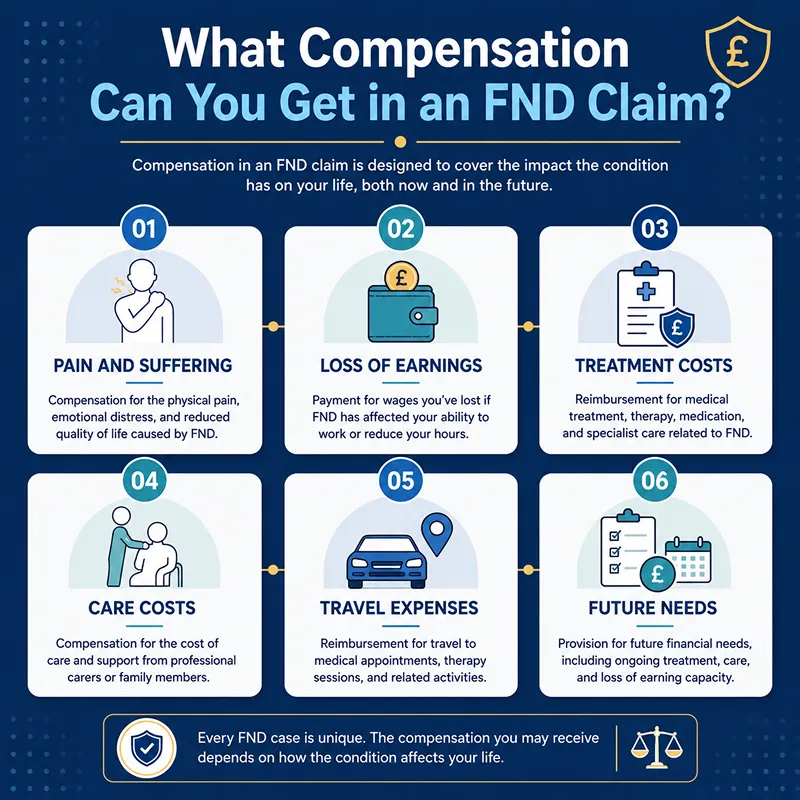
In a functional neurological disorder claim, compensation can cover pain and suffering, loss of earnings, treatment costs, care costs, travel expenses, home adaptations and other financial losses caused by the condition.

Loss of earnings is often a major part of a functional neurological disorder claim. Some people cannot return to work. Others can only work fewer hours or take lower-paid roles.

A UK study found that FND can affect more than health. The average healthcare cost was £3,328 per patient, while lost work costs averaged £6,594 and unpaid care costs averaged £9,255 per patient.

Treatment costs may also be claimed in a functional neurological disorder court claim. This can include physiotherapy, psychological therapy, occupational therapy and rehabilitation.

Claimants may also claim care costs in a functional neurological disorder claim. Some people need help with washing, dressing, cooking, shopping or housework.

If family members provide care, the value of that support may still be part of the functional neurological disorder compensation claim.

Claimants may also recover travel expenses linked to treatment and medical appointments. In serious cases, mobility aids and accommodation needs may also be considered.

Future pension losses may arise if FND affects a person’s working life. Every case is different, so functional neurological disorder compensation must be assessed on individual evidence.

Compensation That May Be Available in an FND Claim

How Does Prognosis Affect Functional Neurological Disorder Compensation?

Prognosis affects functional neurological disorder compensation because it helps show how long the symptoms may last and what future support the claimant may need.

In a functional neurological disorder court claim, medical experts must consider how symptoms are likely to develop in the future. Many people diagnosed with FND improve within a year but this does not mean everyone fully recovers.

Some people have symptoms for many years. Others develop long-term problems that need ongoing care and support. Future losses depend heavily on prognosis.

A person expected to recover quickly may have lower future losses. A person expected to need long-term treatment, care or support may have higher future losses. This is why expert evidence on prognosis is critical.

How to Support People Living With FND During a Functional Neurological Disorder Claim?

People living with FND need support, patience and understanding during a functional neurological disorder claim. The legal process can be stressful, especially when FND causes tiredness, memory problems, anxiety or trouble concentrating. Good legal support should take these needs seriously.

Some people may need shorter meetings. Others may need regular breaks. Some may prefer home visits if mobility is difficult.

Compassion matters because many people with FND have already faced doubt before reaching legal support. Being listened to and believed can make a real difference.

Case Study

Source: Page v Smith [1996] AC 155 (House of Lords). Case commentary: CaseMine Analysis of Page v Smith.

This is a real UK case known as Page v Smith. The claimant was in a road accident caused by another driver. He did not have any physical injuries but the accident made an old health condition much worse. It affected both his mind and body.

The other side said the mental injury could not have been expected because the crash was not very serious. The House of Lords agreed with the claimant.

The court said he was a primary victim because he was directly involved in the accident. This meant he could claim for his psychiatric injury, even without a physical injury.

This case is still important in psychological trauma claims. It shows that a person may be able to claim compensation for psychological trauma when a recognised mental health condition develops after an accident.

Medical evidence and expert reports are still needed in any functional neurological disorder claim. They help prove the condition and show how it affects daily life.

Conclusion

FND is one of the most difficult conditions in personal injury claims. The symptoms are real but they can be hard to explain through normal scans and tests. This creates challenges around diagnosis, causation, evidence and a functional neurological disorder compensation.

Successful functional neurological disorder claims are still possible when the right evidence is gathered. Medical records, witness statements, expert evidence, rehabilitation evidence and financial records all play an important role in a functional neurological disorder court claim.

FND can affect work, relationships, mobility, independence and future plans. It can also cause major financial pressure through lost income, care needs and treatment costs.

The key message is that FND should not be dismissed as something minor or imagined. FND is a recognised medical condition and its symptoms are real. With early diagnosis, proper rehabilitation and strong legal support, people affected by FND can access the treatment, care and functional neurological disorder compensation needed to rebuild their lives after a serious accident.

The medico-legal specialists at Concise Medico understand the complexities of functional neurological disorder claims. Get in touch with us today to discuss your case.

Struggling to prove FND symptoms when scans appear normal?

Our medico-legal experts understand the complexities of functional neurological disorder claims, including complex neurological injuries and disputed causation.
Contact us today and make sure your symptoms, challenges and future needs are properly understood and documented.
Struggling to prove FND symptoms when scans appear normal?

Our medico-legal experts understand the complexities of functional neurological disorder claims, including complex neurological injuries and disputed causation.
Contact us today and make sure your symptoms, challenges and future needs are properly understood and documented.
FAQs

Can I make a claim for functional neurological disorder?2026-06-22T05:43:55+00:00

Yes. You may be able to make a claim if FND was caused, triggered or made worse by an accident that was someone else’s fault. A successful claim usually requires medical evidence, proof that the accident caused the condition and evidence showing how FND has affected daily life, work and finances.

Can I claim personal independence payment (PIP) for functional neurological disorder?2026-06-22T05:44:19+00:00

Yes. People with FND may qualify for PIP if their symptoms affect daily living or mobility. Eligibility depends on how the condition affects everyday activities, not the diagnosis alone. Medical evidence and details about the impact on daily life are usually important.

Is functional neurological disorder a mental illness?2026-06-22T05:44:53+00:00

No. FND is a neurological condition that affects how the brain and nervous system function. Although psychological factors can sometimes contribute to symptoms, people with FND experience real physical symptoms even when scans and tests show no structural damage.

How long does a functional neurological disorder claim take?2026-06-22T05:45:20+00:00

A Functional Neurological Disorder claim can take several months or, in more complex cases, several years. The timescale depends on factors such as disputed causation, the severity of symptoms, medical evidence and the number of experts involved.

What evidence is needed for a functional neurological disorder claim?2026-06-22T05:45:45+00:00

A Functional Neurological Disorder claim usually requires medical records, GP and hospital notes, witness statements, employment records and expert medical reports. This evidence helps show when symptoms began, how they developed and how they affect daily life, work and finances.

Can compensation cover future treatment and care costs?2026-06-22T05:46:09+00:00

Yes. Functional neurological disorder compensation can cover future treatment and care costs where medical evidence supports the need for ongoing help. This may include rehabilitation, therapy, mobility aids, care assistance, future loss of earnings and other long-term financial losses.

Share This Article!

Not every serious injury appears on a scan. A serious road accident, fall or slip may lead to problems with movement, speech, memory, balance or seizure-like episodes, even when MRI and CT scans look normal. This is often the reality for people living with functional neurological disorder (FND).

FND is a recognised neurological condition that affects many people across the UK. According to research, an estimated 50,000 to 100,000 people in the UK are living with FND.

FND is one of the most misunderstood conditions in personal injury claims. The symptoms can be serious and life-changing, yet medical tests may show no clear damage. This makes the condition hard to explain. It can also make a functional neurological disorder claim more difficult.

Some people with FND face doubt from employers, insurers, doctors and even family members. This can feel painful and unfair. The symptoms are real. The impact is real. The financial loss can also be very real, which is why a functional neurological disorder claim may be important for those affected.

When FND develops after an accident caused by someone else’s negligence, important legal questions arise. Did the accident cause the condition? Did it trigger symptoms in someone who was already vulnerable? How can someone prove symptoms when scans appear normal? What compensation can be claimed? These questions matter in functional neurological disorder claims.

Understanding FND, how doctors diagnose it, how functional neurological disorder claims work and how the condition affects personal injury litigation can help claimants take the right steps after an accident.

 Key Takeaways

  • A functional neurological disorder claim can arise when FND is caused, triggered or worsened by an accident linked to someone else’s negligence
  • FND symptoms are real and can affect movement, memory, speech, balance and daily activities even when MRI and CT scans appear normal
  • Early diagnosis and timely rehabilitation can improve recovery outcomes and may strengthen a functional neurological disorder compensation claim
  • Medical records, witness statements and specialist expert evidence are often essential to prove causation and support a functional neurological disorder court claim
  • Compensation may cover pain and suffering, loss of earnings, treatment costs, care costs, travel expenses and future financial losses
  • Prognosis plays a major role in valuing a claim because long-term symptoms can increase future care, rehabilitation and support needs
  • Working with experienced medico-legal experts can help ensure a functional neurological disorder claim is supported by the right evidence and specialist opinions

What Is Functional Neurological Disorder?

Functional neurological disorder is a condition that affects how the brain and nervous system send and receive signals.

Unlike a stroke or multiple sclerosis, FND does not usually cause visible damage to the structure of the brain. The problem is with how the nervous system functions.

Many specialists explain it in a simple way. The brain’s hardware is intact but the software is not working as it should. A person can still experience real neurological symptoms even when scans and tests look normal. That can affect daily life in a serious way.

In the past, FND was often called hysteria or conversion disorder. Today, doctors understand FND as a complex condition that sits between neurology and psychiatry.

This is why a functional neurological disorder claim often needs clear medical evidence from the start.

1. What Are the Common Symptoms of FND?

FND symptoms can look different from person to person. For some people, symptoms stay mild. For others, they affect work, independence and everyday life. Following are the common symptoms of FND:

Important:

Even a short delay can affect cancer treatment options. As cancer progresses, it may spread to nearby tissues or other parts of the body, making treatment more complex and reducing the chances of a successful outcome.

  • Functional limb weakness is common. A person may feel weakness in an arm or leg even when doctors cannot find structural nerve damage.
  • Functional movement disorders may cause tremors, spasms, jerking movements or unusual walking patterns.
  • Functional tremor can cause shaking in the hands, arms, legs, neck or body.
  • Functional gait disorder affects walking. A person may struggle with balance, coordination and mobility.
  • Functional sensory symptoms may include numbness, pins and needles, reduced feeling or altered sensation in parts of the body.
  • Some people experience functional seizures. These are also called dissociative seizures or non-epileptic attacks. They may look like epileptic seizures but they are caused by different processes in the nervous system.
  • Cognitive symptoms are also common. Many people report brain fog, poor memory, poor concentration and difficulty processing information.
  • Speech may also be affected. Some people develop stuttering, slurred speech or difficulty finding words.
  • Some people also experience visual symptoms, hearing problems or swallowing issues.
  • Many people with FND also have fatigue, headaches, chronic pain, poor sleep, anxiety and low mood.

2. Can Other Health Conditions Cause Similar Symptoms?

Yes, other health conditions can sometimes cause similar symptoms. This does not mean the person is lying. It only means doctors must check the diagnosis carefully.

Some people may have FND and another brain or nerve condition at the same time. Others may also have anxiety, depression, post-traumatic stress disorder (PTSD) or long-term pain.

In rare cases, doctors may also consider ‘Illness Anxiety Disorder’ or ‘Factitious Disorder’. The goal is not to ignore the symptoms. The goal is to find the correct diagnosis. This matters because the diagnosis can affect the claim, treatment and compensation.

3. Why Are FND Symptoms Often Misunderstood?

One major reason is that symptoms can change. A person may manage quite well one day and struggle badly the next day. Sometimes symptoms change within the same day. Someone may walk without help in the morning but need support later because of fatigue, weakness or pain. This can confuse people around them.

An employer may not understand why a person can do a task one day but not the next. A family member may feel unsure what is happening. An insurer may wrongly think changing symptoms mean the condition is exaggerated.

Fluctuation is a known feature of FND. The fact that symptoms change does not mean they are false.

Some symptoms may also improve for a short time when attention is moved elsewhere. This can seem strange but doctors who understand FND know how to assess these signs properly.

This is why specialist medical evidence is so important in functional neurological disorder claims.

4. What Causes Functional Neurological Disorder?

FND does not have one clear cause. Doctors believe it can happen because of many different things working together. These may include stress, trauma, mental health problems, neurological conditions, illness or physical injury. In some people, an accident or traumatic event can trigger FND symptoms.

Doctors sometimes explain FND with three simple factors, such as:

  • Predisposing factors: These are things that may make a person more likely to develop FND. These can include past trauma, long-term stress, anxiety, depression or difficult life events
  • Precipitating factors: These are things that start the symptoms. These may include an accident, injury, illness, surgery or a traumatic event
  • Perpetuating factors: These are things that keep symptoms going. These may include stress, fear of symptoms, less activity, emotional difficulties or the stress of a legal claim

Not everyone with FND has a clear mental health trigger. Some people develop FND after a physical injury with no past trauma or mental health issue. This is why doctors must look at each case carefully.

Can a Minor Accident Trigger FND?

Yes, in some cases. The cost of future care is an important point in personal injury claims. Defendants and insurers may argue that a minor accident could not cause serious symptoms. However, the severity of the accident does not always match the severity of FND symptoms.

A person may leave a low-impact accident and later develop serious functional symptoms. This does not mean the symptoms are not real.

FND appears to involve how the nervous system responds to the event. It is not only about the level of physical damage. This is one reason why causation is often disputed in functional neurological disorder claims.

How Is FND Diagnosed?

FND is usually diagnosed by a neurologist who understands the condition. The doctor will review the person’s medical history, symptoms, examination findings and test results. Doctors also look at triggers and symptom changes that hints towards FND.

There is no single blood test, brain scan or investigation that confirms FND. MRI and CT scans are often normal.

Some clinical signs may support the diagnosis. For example, functional weakness may show patterns that are different from weakness caused by structural neurological disease.

The diagnosis must still be careful. The symptoms should not be the result of another neurological or mental health condition.

At the same time, FND can exist with other conditions. A person may have FND and a brain injury. A person may have FND and chronic pain. A person may have FND and depression. This makes proper assessment very important. A clear diagnosis can also help support a functional neurological disorder claim by showing what condition is present.

FND vs Structural Neurological Conditions

Why Does Early Diagnosis Matter?

Early diagnosis matters because it can stop people from getting treatment they do not need. Some people with FND have many tests before doctors find the right diagnosis. This can slow down recovery.

When doctors diagnose FND early, treatment and rehabilitation can start sooner. Many people do better when they get help early.

A clear diagnosis also helps the person understand what is happening to their body. For many people, this feels like the first step towards recovery.

Early Action Matters:

Early diagnosis and rehabilitation can improve recovery outcomes in FND.

Sadly, some doctors and clinics still do not understand FND well. This means many people wait too long for the right diagnosis.

How Does FND Affect A Personal Injury Claim?

FND can make a personal injury claim more complex because the symptoms are often serious but standard medical tests may appear normal.

A broken bone may appear on an X-ray. A spinal injury may appear on an MRI scan. FND is different. Symptoms may be severe but standard tests may appear normal. This can lead to doubt from insurers and defendants. One key question is whether the accident caused the FND.

In some cases, symptoms begin soon after the accident. In others, they appear weeks or months later. This delay can create arguments about causation.

A defendant may say the symptoms are not linked to the accident. They may argue that another factor caused them. They may also say the claimant was already vulnerable and would have developed FND anyway. This is why strong medical evidence is needed to support a functional neurological disorder claim.

What Evidence Helps Prove a Functional Neurological Disorder Claim?

Medical records are a good place to start when proving a functional neurological disorder claim. These records show the person’s health before and after the accident. GP notes, hospital records, physio records and mental health records may all help.

Doctors will check if there were any FND symptoms before the accident. If the symptoms only started after the accident, this may support the functional neurological disorder claim.

Witness statements can also help. Family members may explain how FND affects the person every day. Friends, workmates and carers can also share what they have seen.

Work records may show time off, lower pay or changes in job duties. Care records may show what help the person now needs. All this evidence helps show how life changed after the accident.

Why Are Expert Witnesses So Important in a Functional Neurological Disorder Claim?

Functional neurological disorder claims often need expert doctors because FND can be hard to understand. It is linked to both the brain and mental health, so a normal doctor may not have enough specialist knowledge to explain it fully.

A neurologist can help confirm the FND diagnosis. They can also check if another nerve or brain condition is causing the symptoms.

A psychiatrist or neuropsychiatrist can look at stress, trauma, mental health and recovery chances.

A psychologist can explain what treatment may help and how the symptoms affect daily life.

Other experts may also help. These can include pain experts, care experts, work experts and occupational therapists.

All experts should work together. This helps give a clear picture of the claimant’s condition, needs and future support.

Can People With FND Be Wrongly Accused of Exaggerating Symptoms?

Yes, this can happen in a functional neurological disorder claim. FND symptoms can change from day to day. A person may look better one day and worse the next. This does not mean they are lying.

Malingering is different from FND. Malingering means a person knowingly makes up or exaggerates symptoms for money or personal gain.

FND is not malingering. People with FND have real symptoms, even when medical tests look normal. However, the condition is still poorly understood and some claimants may be accused of exaggerating. This can be very upsetting for them.

Key Point:

Consistent medical evidence is often crucial in FND claims.

If a court finds fundamental dishonesty, the claim may be dismissed. This is why strong evidence matters. Medical records, witness statements and expert reports should support the claimant’s account.

Can Surveillance Evidence Be Used in a Functional Neurological Disorder Claim?

In some functional neurological disorder claims, defendants may use surveillance. This means someone may record what the claimant does in daily life. They may compare this with what the claimant has said about their symptoms.

This can be tricky in FND cases because symptoms can change. A short video may only show one small part of the day. A person may walk normally for a short time. Later, they may struggle with tiredness, weakness or pain. This does not always mean the person is exaggerating.

Surveillance evidence should be checked with the full medical evidence and the nature of FND.

What Treatment and Rehabilitation Options Are Available for FND?

Many people with FND can get better with early care. Treatment works best when different experts work together.

  • Cognitive Behavioural Therapy (CBT): Helps people understand thoughts, feelings and symptoms
  • Physiotherapy: Helps with weakness, movement and walking
  • Occupational therapy: Helps with daily tasks and independence
  • Speech and language therapy: Helps with speech or swallowing problems
  • Psychological therapy: Helps with trauma, anxiety, low mood or low confidence
  • Intensive rehabilitation: Helps in serious cases when more specialist care is needed

What Is the Importance of Interim Payments?

An interim payment is money paid before a functional neurological disorder claim reaches final settlement. It can help pay for therapy, rehabilitation, equipment or urgent medical costs.

Serious FND claims can take a long time. People with FND may need treatment before the case ends, so interim payments can provide early support. Legal teams may also use the rehabilitation code to encourage insurers to fund treatment early, even where liability is still disputed. Early support can give the injured person a better chance of recovery.

What Compensation Can You Get in a Functional Neurological Disorder Claim?

In a functional neurological disorder claim, compensation can cover pain and suffering, loss of earnings, treatment costs, care costs, travel expenses, home adaptations and other financial losses caused by the condition.

Loss of earnings is often a major part of a functional neurological disorder claim. Some people cannot return to work. Others can only work fewer hours or take lower-paid roles.

A UK study found that FND can affect more than health. The average healthcare cost was £3,328 per patient, while lost work costs averaged £6,594 and unpaid care costs averaged £9,255 per patient.

Treatment costs may also be claimed in a functional neurological disorder court claim. This can include physiotherapy, psychological therapy, occupational therapy and rehabilitation.

Claimants may also claim care costs in a functional neurological disorder claim. Some people need help with washing, dressing, cooking, shopping or housework.

If family members provide care, the value of that support may still be part of the functional neurological disorder compensation claim.

Claimants may also recover travel expenses linked to treatment and medical appointments. In serious cases, mobility aids and accommodation needs may also be considered.

Future pension losses may arise if FND affects a person’s working life. Every case is different, so functional neurological disorder compensation must be assessed on individual evidence.

Compensation That May Be Available in an FND Claim

How Does Prognosis Affect Functional Neurological Disorder Compensation?

Prognosis affects functional neurological disorder compensation because it helps show how long the symptoms may last and what future support the claimant may need.

In a functional neurological disorder court claim, medical experts must consider how symptoms are likely to develop in the future. Many people diagnosed with FND improve within a year but this does not mean everyone fully recovers.

Some people have symptoms for many years. Others develop long-term problems that need ongoing care and support. Future losses depend heavily on prognosis.

A person expected to recover quickly may have lower future losses. A person expected to need long-term treatment, care or support may have higher future losses. This is why expert evidence on prognosis is critical.

How to Support People Living With FND During a Functional Neurological Disorder Claim?

People living with FND need support, patience and understanding during a functional neurological disorder claim. The legal process can be stressful, especially when FND causes tiredness, memory problems, anxiety or trouble concentrating. Good legal support should take these needs seriously.

Some people may need shorter meetings. Others may need regular breaks. Some may prefer home visits if mobility is difficult.

Compassion matters because many people with FND have already faced doubt before reaching legal support. Being listened to and believed can make a real difference.

Case Study

Source: Page v Smith [1996] AC 155 (House of Lords). Case commentary: CaseMine Analysis of Page v Smith.

This is a real UK case known as Page v Smith. The claimant was in a road accident caused by another driver. He did not have any physical injuries but the accident made an old health condition much worse. It affected both his mind and body.

The other side said the mental injury could not have been expected because the crash was not very serious. The House of Lords agreed with the claimant.

The court said he was a primary victim because he was directly involved in the accident. This meant he could claim for his psychiatric injury, even without a physical injury.

This case is still important in psychological trauma claims. It shows that a person may be able to claim compensation for psychological trauma when a recognised mental health condition develops after an accident.

Medical evidence and expert reports are still needed in any functional neurological disorder claim. They help prove the condition and show how it affects daily life.

Conclusion

FND is one of the most difficult conditions in personal injury claims. The symptoms are real but they can be hard to explain through normal scans and tests. This creates challenges around diagnosis, causation, evidence and a functional neurological disorder compensation.

Successful functional neurological disorder claims are still possible when the right evidence is gathered. Medical records, witness statements, expert evidence, rehabilitation evidence and financial records all play an important role in a functional neurological disorder court claim.

FND can affect work, relationships, mobility, independence and future plans. It can also cause major financial pressure through lost income, care needs and treatment costs.

The key message is that FND should not be dismissed as something minor or imagined. FND is a recognised medical condition and its symptoms are real. With early diagnosis, proper rehabilitation and strong legal support, people affected by FND can access the treatment, care and functional neurological disorder compensation needed to rebuild their lives after a serious accident.

The medico-legal specialists at Concise Medico understand the complexities of functional neurological disorder claims. Get in touch with us today to discuss your case.

Struggling to prove FND symptoms when scans appear normal?

Our medico-legal experts understand the complexities of functional neurological disorder claims, including complex neurological injuries and disputed causation.
Contact us today and make sure your symptoms, challenges and future needs are properly understood and documented.
Struggling to prove FND symptoms when scans appear normal?

Our medico-legal experts understand the complexities of functional neurological disorder claims, including complex neurological injuries and disputed causation.
Contact us today and make sure your symptoms, challenges and future needs are properly understood and documented.

FAQs

Can I make a claim for functional neurological disorder?2026-06-22T05:43:55+00:00

Yes. You may be able to make a claim if FND was caused, triggered or made worse by an accident that was someone else’s fault. A successful claim usually requires medical evidence, proof that the accident caused the condition and evidence showing how FND has affected daily life, work and finances.

Can I claim personal independence payment (PIP) for functional neurological disorder?2026-06-22T05:44:19+00:00

Yes. People with FND may qualify for PIP if their symptoms affect daily living or mobility. Eligibility depends on how the condition affects everyday activities, not the diagnosis alone. Medical evidence and details about the impact on daily life are usually important.

Is functional neurological disorder a mental illness?2026-06-22T05:44:53+00:00

No. FND is a neurological condition that affects how the brain and nervous system function. Although psychological factors can sometimes contribute to symptoms, people with FND experience real physical symptoms even when scans and tests show no structural damage.

How long does a functional neurological disorder claim take?2026-06-22T05:45:20+00:00

A Functional Neurological Disorder claim can take several months or, in more complex cases, several years. The timescale depends on factors such as disputed causation, the severity of symptoms, medical evidence and the number of experts involved.

What evidence is needed for a functional neurological disorder claim?2026-06-22T05:45:45+00:00

A Functional Neurological Disorder claim usually requires medical records, GP and hospital notes, witness statements, employment records and expert medical reports. This evidence helps show when symptoms began, how they developed and how they affect daily life, work and finances.

Can compensation cover future treatment and care costs?2026-06-22T05:46:09+00:00

Yes. Functional neurological disorder compensation can cover future treatment and care costs where medical evidence supports the need for ongoing help. This may include rehabilitation, therapy, mobility aids, care assistance, future loss of earnings and other long-term financial losses.

Go to Top