TABLE OF CONTENT
- Letter of Claim Pre Action Protocol Explained (PAP)
- Letter of Claim Pre Action Protocol Explained (PAP)
- What is a Letter of Claim and Why It Matters
- Is a Letter of Claim the Same as a Letter Before Action?
- When Do You Need a Letter of Claim?
- What Should a Letter of Claim Include?
- How Long Should Time Be Allowed to Receive?
- What to Do After Sending a Letter of Claim?
- Solicitor’s Letter Before Action.
- Can You Write a Letter of Claim Yourself?
- Common Mistakes to Avoid
- Is a Claim Letter a Legal Contract?
- Letter Before Action vs Going Straight to Court.
- What Should You Do When You Receive a Letter Before Claim?
- Case Study: How a Letter of Claim Prevented Court Action
- When Should You Seek Legal Advice?
- Final Thoughts: A Legal Tool
- FAQs
A letter of claim is a formal document sent to a defendant before legal proceedings begin. This document is sent as part of the procedure in line with the Civil Procedure Rules. It helps both parties settle out of court.
This letter is the first step in a legal dispute. It contains information, such as:
- Details of both parties.
- Summary of events.
- Legal reasons for the case.
- Remedy sought.
- Deadline for response.
The goal is to give clear information to both parties in the interest of fairness.
For many cases in the UK, sending a letter of claim is not optional. It is part of the rules that must be followed before going to court.
Letter of Claim Pre Action Protocol Explained (PAP)
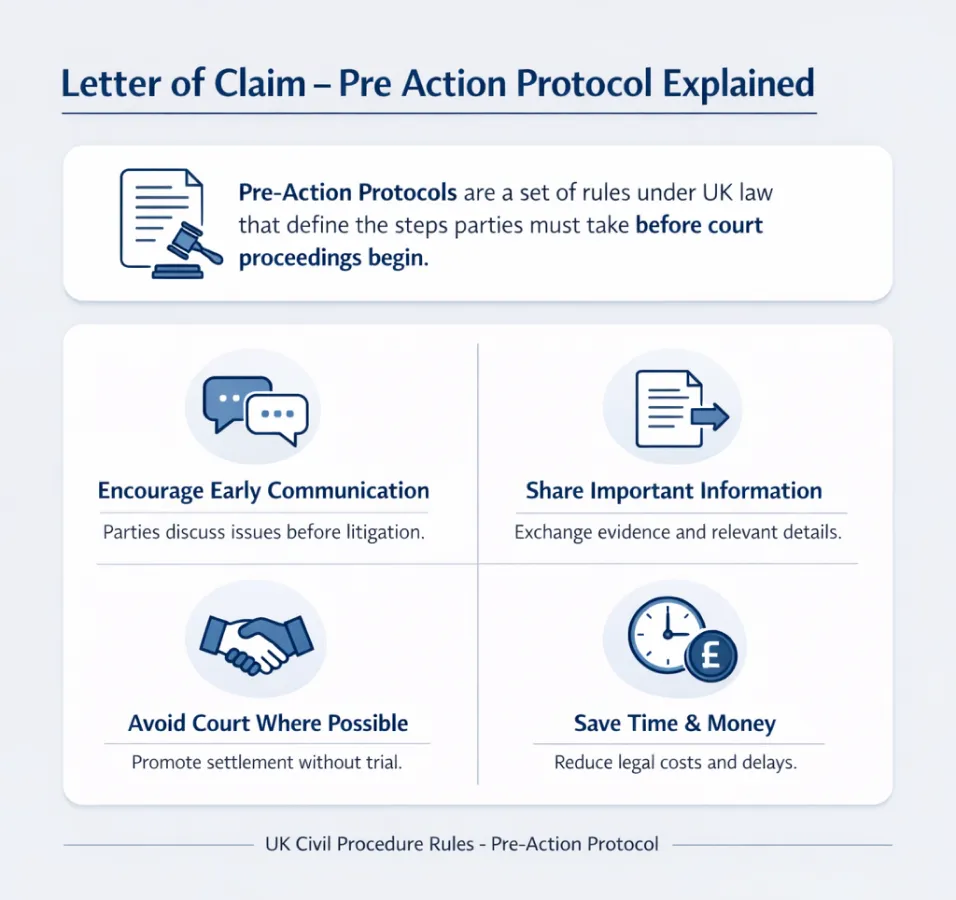
Pre-Action Protocols are a set of rules, under UK law, that define the actions necessary before a trial commences. Pre-action protocols aim to:
- Encourage early communication.
- Share important information.
- Avoid court where possible.
- Save time and money.
Different cases have different protocols. For example, injury claims follow different steps than debt claims.
Letter of Claim Pre Action Protocol Explained (PAP)
Pre-Action Protocols are a set of rules, under UK law, that define the actions necessary before a trial commences. Pre-action protocols aim to:
- Encourage early communication.
- Share important information.
- Avoid court where possible.
- Save time and money.
Different cases have different protocols. For example, injury claims follow different steps than debt claims.
CPR Letter of Claim and Court Rules
A CPR letter prior to claim follows the Civil Procedure Rules. These are the main rules that control civil courts in the UK. Sending a letter before making a formal claim is required under UK law. It must detail:
- Basis of the claim.
- Facts related to the case.
- Key documents.
- A timeframe for response.
Failure to send a letter may result in a penalty.
What is a Letter of Claim and Why It Matters
A letter of claim is an attempt to bring clarity to all parties before court proceedings begin. A letter before claim gives both parties a fair chance to avoid court. It gives all the important information regarding legal grounds, facts and claims made in a legal proceeding.
A letter prior to the formal claim matters because courts expect people to try an early settlement. Courts may view this negatively if you skip it.
It also helps both sides understand the case better. There are fewer surprises and more time to think clearly.
Is a Letter of Claim the Same as a Letter Before Action?
You might hear people use different names for the same thing. Both terms serve the same purpose.
These letters are sent before the court action starts.
- A letter before claim is usually used for claims that come under the Civil Procedure Rules.
- A letter before action is mostly used for cases that involve debt recovery.
The wording can change depending on the type of case. The terms basically mean the same thing.
A letter before action is a very common phrase. It is often used by solicitors and businesses when warning that court is the next step.
When Do You Need a Letter of Claim?
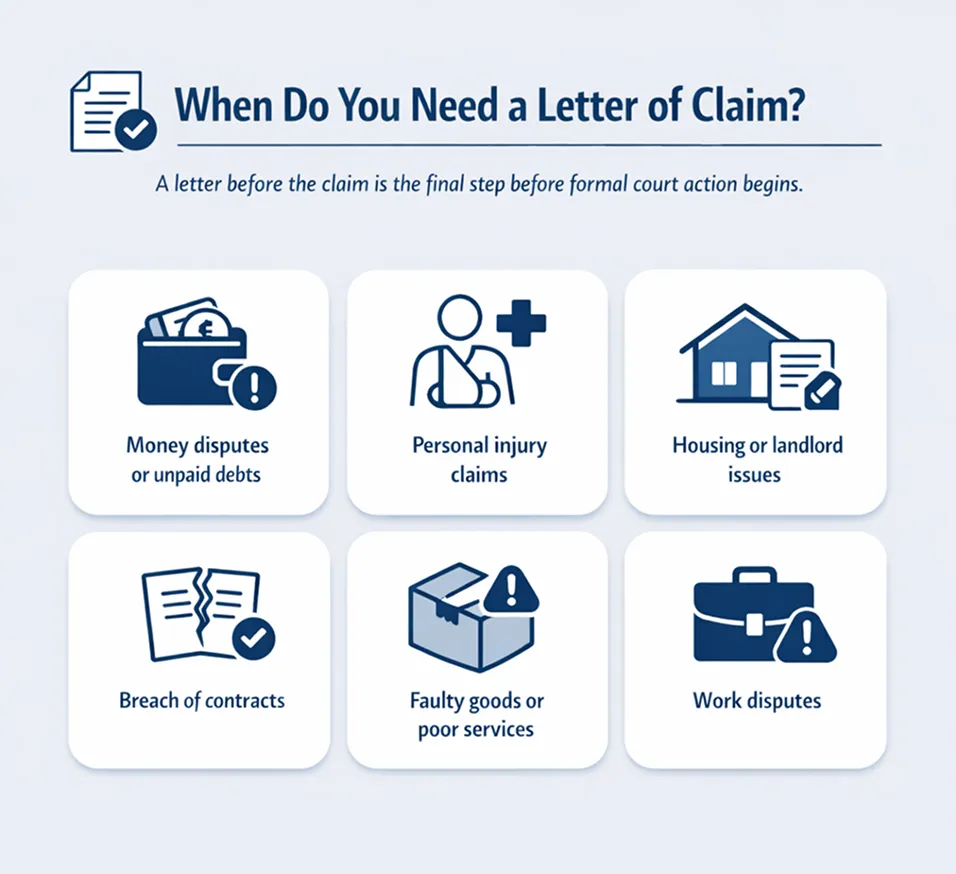
A letter before the claim is needed as the final step before formal court action can begin. The cases in question can be:
- Money disputes or unpaid debts.
- Personal injury claims.
- Housing or landlord issues.
- Breach of contracts.
- Faulty goods or poor services.
- Work disputes.
Sending a letter before legal action can help settle the case out of court. In the UK, it is crucial for compliance with Pre-Action Protocols. Failure to send one can result in penalties.
An early settlement saves time and money.
What Should a Letter of Claim Include?
A good claim letter is clear and detailed. It should explain the problem without using angry language.
Most letters of claim include:
- Your name and contact details.
- The other party’s details.
- A clear summary of what happened.
- Why do you believe they are at fault?
- What do you want to resolve the issue?
- A deadline for a response.
Keeping it simple helps everyone understand the issue.
How Long Should Time Be Allowed to Receive?
Once a letter of the claim has been sent, the other party should be allowed time to respond. It is a time that is contingent upon the kind of case.
The common response times are:
- 14 days for simple debt claims.
- 30 days for more complex cases.
- More time when documents are to be reviewed.
Going to court too fast will come back to haunt you.
What to Do After Sending a Letter of Claim?
After the letter has been received, the other side has options. They are able to concur, dissent or request time.
They may:
- Accept responsibility.
- Offer a settlement.
- Deny the claim.
- Ask for evidence.
A large number of cases are resolved at this stage. That spares the headaches and the cash for all.
Solicitor’s Letter Before Action.
A letter before action is a letter which is drafted by a qualified solicitor. It gives an account of the legal conflict and outlines the demands. It normally weighs more and leads to settlements.
These letters:
- Strictly adhere to legal procedures.
- Speak harsh but business-like.
- Set clear deadlines.
Getting one does not imply that the case is lost. It means the issue is serious.
Can You Write a Letter of Claim Yourself?
You may make a letter before claim or a letter prior to action at your own risk. Some individuals do it on minor disagreements.
Nevertheless, the legal terminology has to be correct. A letter that is not well written may undermine your position.
Legal advice could be prudent in more complex or more valuable cases.
Common Mistakes to Avoid
In the writing or answering a letter before claim or a letter prior to action, there are certain errors that are prevalent.
Try to avoid:
- Using rude or angry language.
- Making threats.
- Hiding key facts.
- Missing deadlines.
By remaining calm and straight, you are better off.
Is a Claim Letter a Legal Contract?
An order of the court is not a letter that precedes the claim. You do not receive one simply to be punished. Nevertheless, it has legal significance. It is evidence of reasonable behaviour in courts.
The way you behave after getting it can be significant later.
Letter Before Action vs Going Straight to Court.
Certain individuals believe that it is quicker to go directly to court. Often, it is not.
A letter prior to action can:
- Save months of waiting.
- Reduce legal costs.
- Lower stress.
Courts favour individuals who make the first attempt.
What Should You Do When You Receive a Letter Before Claim?
Do not panic in case you are getting a letter before the claim. Read it thoroughly.
Helpful steps include:
- Read the letter slowly.
- Check deadlines.
- Gather documents..
- Get advice if needed.
Ignoring it rarely helps.
Case Study: How a Letter of Claim Prevented Court Action
This brief case study demonstrates the way a claim letter is utilised in practice. It is grounded upon a widespread dispute in the UK.
The Situation
A client had services offered to him by a small business. This work was done, yet the final invoice was not paid.
Emails were sent first. Phone calls followed. The problem was yet to be solved.
At this point, the business voted to dispatch a letter of claim.
The Letter Prior to Claim
The business did the pre-claim preparation of a clear letter with the assistance of professional solicitors. It explained:
- What services were provided?
- When payment was due.
- The amount owed.
- Why was the client in breach?
The pre-action protocol was also mentioned in the letter and 14 days provided to respond was available.
The Response to the Letter
The client responded to the letter in a period of one week.
They did not deny the debt. Instead, they demanded time to pay. Without going to court, a short plan of payment was agreed upon.
Why the Letter Worked
This claim letter was effective since it was composed and peaceful.
It was in line with CPR and willingness to resolve the issue. The client realised that the next way to go was the court in case they disobeyed.
When Should You Seek Legal Advice?
Legal advice is helpful when the claim is complex or high-value. A solicitor can guide your response.
As Abraham Lincoln noted, “A good settlement is better than a good lawsuit.”
They can also draft a reply that follows CPR rules. This reduces the risk of mistakes.
Final Thoughts: A Legal Tool
Letters of the claim are about fair trials. They give a clear opportunity to correct the situation.It is not about a hurry to the court. It’s about communication.
The knowledge of the working process places you in a better position, regardless of which side you are taking.
At Concise Medico, we help by providing:
- Clear and simple communication.
- Accurate timelines and evidence.
- Easy-to-understand reports.
- Support that fits the legal process.
Contact us now to get the right support, which leads to fairer and clearer results.
FAQs
A letter of claim is a formal document sent to a defendant before legal proceedings begin. This document is sent as part of the procedure in line with the Civil Procedure Rules. It helps both parties settle out of court.
This letter is the first step in a legal dispute. It contains information, such as:
- Details of both parties.
- Summary of events.
- Legal reasons for the case.
- Remedy sought.
- Deadline for response.
The goal is to give clear information to both parties in the interest of fairness.
For many cases in the UK, sending a letter of claim is not optional. It is part of the rules that must be followed before going to court.
Letter of Claim Pre Action Protocol Explained (PAP)
Pre-Action Protocols are a set of rules, under UK law, that define the actions necessary before a trial commences. Pre-action protocols aim to:
- Encourage early communication.
- Share important information.
- Avoid court where possible.
- Save time and money.
Different cases have different protocols. For example, injury claims follow different steps than debt claims.
Letter of Claim Pre Action Protocol Explained (PAP)
Pre-Action Protocols are a set of rules, under UK law, that define the actions necessary before a trial commences. Pre-action protocols aim to:
- Encourage early communication.
- Share important information.
- Avoid court where possible.
- Save time and money.
Different cases have different protocols. For example, injury claims follow different steps than debt claims.
CPR Letter of Claim and Court Rules
A CPR letter prior to claim follows the Civil Procedure Rules. These are the main rules that control civil courts in the UK. Sending a letter before making a formal claim is required under UK law. It must detail:
- Basis of the claim.
- Facts related to the case.
- Key documents.
- A timeframe for response.
Failure to send a letter may result in a penalty.
What is a Letter of Claim and Why It Matters
A letter of claim is an attempt to bring clarity to all parties before court proceedings begin. A letter before claim gives both parties a fair chance to avoid court. It gives all the important information regarding legal grounds, facts and claims made in a legal proceeding.
A letter prior to the formal claim matters because courts expect people to try an early settlement. Courts may view this negatively if you skip it.
It also helps both sides understand the case better. There are fewer surprises and more time to think clearly.
Is a Letter of Claim the Same as a Letter Before Action?
You might hear people use different names for the same thing. Both terms serve the same purpose.
These letters are sent before the court action starts.
- A letter before claim is usually used for claims that come under the Civil Procedure Rules.
- A letter before action is mostly used for cases that involve debt recovery.
The wording can change depending on the type of case. The terms basically mean the same thing.
A letter before action is a very common phrase. It is often used by solicitors and businesses when warning that court is the next step.
When Do You Need a Letter of Claim?
A letter before the claim is needed as the final step before formal court action can begin. The cases in question can be:
- Money disputes or unpaid debts.
- Personal injury claims.
- Housing or landlord issues.
- Breach of contracts.
- Faulty goods or poor services.
- Work disputes.
Sending a letter before legal action can help settle the case out of court. In the UK, it is crucial for compliance with Pre-Action Protocols. Failure to send one can result in penalties.
An early settlement saves time and money.
What Should a Letter of Claim Include?
A good claim letter is clear and detailed. It should explain the problem without using angry language.
Most letters of claim include:
- Your name and contact details.
- The other party’s details.
- A clear summary of what happened.
- Why do you believe they are at fault?
- What do you want to resolve the issue?
- A deadline for a response.
Keeping it simple helps everyone understand the issue.
How Long Should Time Be Allowed to Receive?
Once a letter of the claim has been sent, the other party should be allowed time to respond. It is a time that is contingent upon the kind of case.
The common response times are:
- 14 days for simple debt claims.
- 30 days for more complex cases.
- More time when documents are to be reviewed.
Going to court too fast will come back to haunt you.
What to Do After Sending a Letter of Claim?
After the letter has been received, the other side has options. They are able to concur, dissent or request time.
They may:
- Accept responsibility.
- Offer a settlement.
- Deny the claim.
- Ask for evidence.
A large number of cases are resolved at this stage. That spares the headaches and the cash for all.
Solicitor’s Letter Before Action.
A letter before action is a letter which is drafted by a qualified solicitor. It gives an account of the legal conflict and outlines the demands. It normally weighs more and leads to settlements.
These letters:
- Strictly adhere to legal procedures.
- Speak harsh but business-like.
- Set clear deadlines.
Getting one does not imply that the case is lost. It means the issue is serious.
Can You Write a Letter of Claim Yourself?
You may make a letter before claim or a letter prior to action at your own risk. Some individuals do it on minor disagreements.
Nevertheless, the legal terminology has to be correct. A letter that is not well written may undermine your position.
Legal advice could be prudent in more complex or more valuable cases.
Common Mistakes to Avoid
In the writing or answering a letter before claim or a letter prior to action, there are certain errors that are prevalent.
Try to avoid:
- Using rude or angry language.
- Making threats.
- Hiding key facts.
- Missing deadlines.
By remaining calm and straight, you are better off.
Is a Claim Letter a Legal Contract?
An order of the court is not a letter that precedes the claim. You do not receive one simply to be punished. Nevertheless, it has legal significance. It is evidence of reasonable behaviour in courts.
The way you behave after getting it can be significant later.
Letter Before Action vs Going Straight to Court.
Certain individuals believe that it is quicker to go directly to court. Often, it is not.
A letter prior to action can:
- Save months of waiting.
- Reduce legal costs.
- Lower stress.
Courts favour individuals who make the first attempt.
What Should You Do When You Receive a Letter Before Claim?
Do not panic in case you are getting a letter before the claim. Read it thoroughly.
Helpful steps include:
- Read the letter slowly.
- Check deadlines.
- Gather documents..
- Get advice if needed.
Ignoring it rarely helps.
Case Study: How a Letter of Claim Prevented Court Action
This brief case study demonstrates the way a claim letter is utilised in practice. It is grounded upon a widespread dispute in the UK.
The Situation
A client had services offered to him by a small business. This work was done, yet the final invoice was not paid.
Emails were sent first. Phone calls followed. The problem was yet to be solved.
At this point, the business voted to dispatch a letter of claim.
The Letter Prior to Claim
The business did the pre-claim preparation of a clear letter with the assistance of professional solicitors. It explained:
- What services were provided?
- When payment was due.
- The amount owed.
- Why was the client in breach?
The pre-action protocol was also mentioned in the letter and 14 days provided to respond was available.
The Response to the Letter
The client responded to the letter in a period of one week.
They did not deny the debt. Instead, they demanded time to pay. Without going to court, a short plan of payment was agreed upon.
Why the Letter Worked
This claim letter was effective since it was composed and peaceful.
It was in line with CPR and willingness to resolve the issue. The client realised that the next way to go was the court in case they disobeyed.
When Should You Seek Legal Advice?
Legal advice is helpful when the claim is complex or high-value. A solicitor can guide your response.
As Abraham Lincoln noted, “A good settlement is better than a good lawsuit.”
They can also draft a reply that follows CPR rules. This reduces the risk of mistakes.
Final Thoughts: A Legal Tool
Letters of the claim are about fair trials. They give a clear opportunity to correct the situation.It is not about a hurry to the court. It’s about communication.
The knowledge of the working process places you in a better position, regardless of which side you are taking.
At Concise Medico, we help by providing:
- Clear and simple communication.
- Accurate timelines and evidence.
- Easy-to-understand reports.
- Support that fits the legal process.
Contact us now to get the right support, which leads to fairer and clearer results.