Can You Get a Medico-Legal Report Within 2 Weeks?
Need a medico-legal report within two weeks? It may be possible, but the answer depends on more than how quickly an expert can write one.
A medico-legal report must provide an independent, evidence-based opinion that can withstand legal scrutiny. The expert may need to review medical records, examine the claimant, consider the relevant clinical questions and prepare a report that meets the requirements for expert evidence.
So, what affects the turnaround time?
In some straightforward cases, a report may be completed within two weeks. More complex cases can take considerably longer. Understanding what can speed up or delay the process can help solicitors plan ahead and allow enough time for a properly prepared report.
What Is a Typical Turnaround Time for a Medico-Legal Report?
There is no standard UK turnaround time for medico-legal reporting in the UK.
Some medical experts advertise turnaround times of around two weeks, while others have standard timeframes of several weeks or longer. For example, individual UK medical experts publicly state turnaround times ranging from approximately two weeks to six to eight weeks, depending on their speciality and workload.
This variation matters. A two-week turnaround should be agreed with the specific expert rather than assumed to be standard across the medico-legal sector.
The type of report also affects the timeframe. A straightforward personal injury assessment may require less work than a complex clinical negligence case involving years of medical records and several disputed issues.
What Affects Medico-Legal Report Turnaround Time?
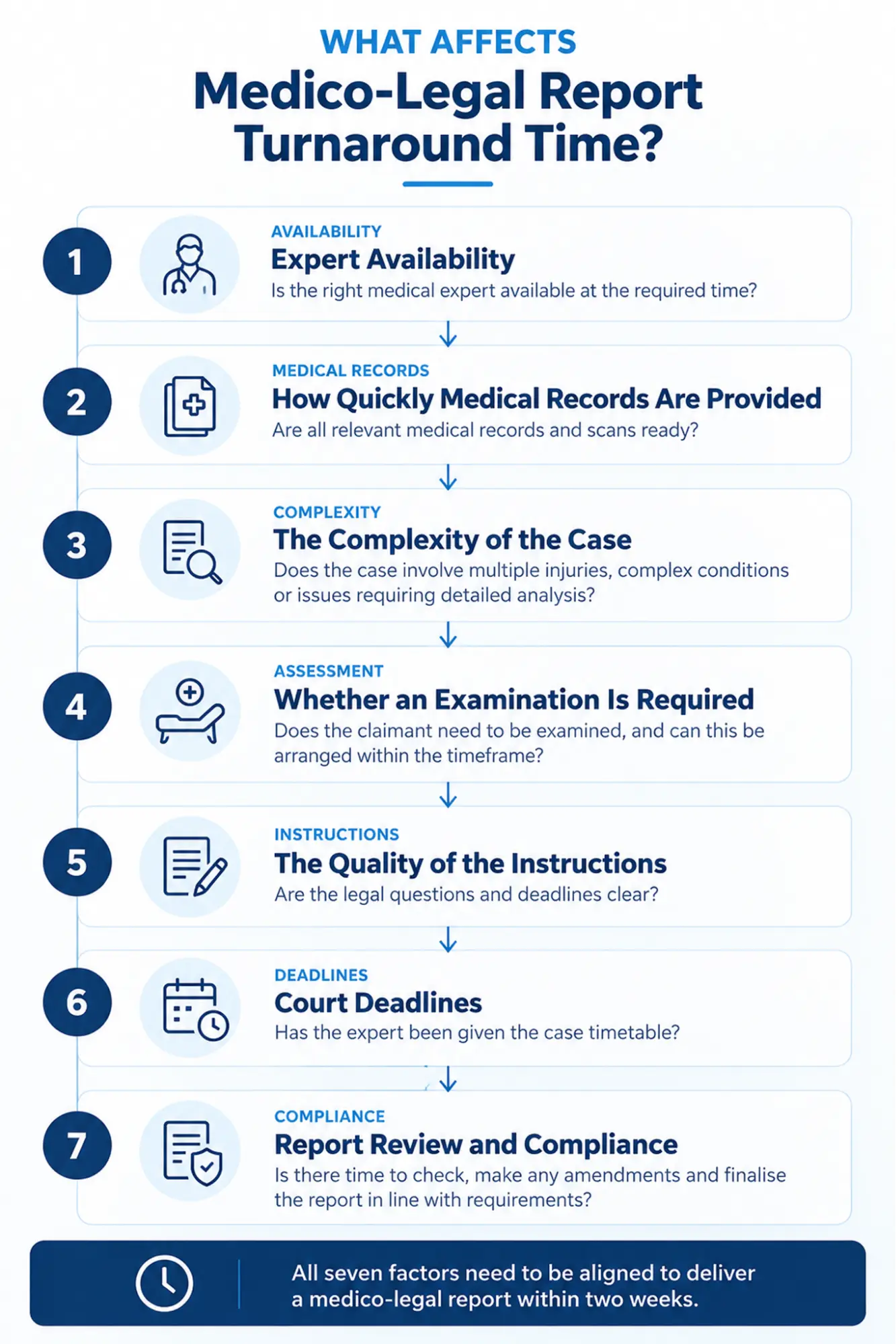
Several factors can influence how quickly an expert can prepare and deliver a report. Understanding these factors can help solicitors identify potential delays before they become a problem.
1. Expert Availability
The first question is whether the appropriate expert is available.
A solicitor may need a consultant in a particular speciality, such as orthopaedics, neurology, psychiatry, pain medicine or radiology. The more specialised the expertise required, the smaller the pool of suitable experts may be.
Guidance from the Courts and Tribunals Judiciary highlights the importance of considering an expert’s availability when planning the work. Those instructing experts should also provide an outline programme for completing and delivering each stage.
Therefore, finding an expert who is both suitably qualified and available within two weeks is often the first challenge.
2. How Quickly Medical Records Are Provided
Medical records can have a major effect on turnaround time.
An expert cannot properly assess a case if important records are missing. Depending on the claim, these may include:
- GP records
- Hospital notes
- Imaging and scan reports
- Operative reports
- Treatment records
- Rehabilitation records
- Previous expert reports
Guidance from the Courts and Tribunals Judiciary recommends providing relevant documents with the instructions and ensuring that the expert has the material needed to prepare the report.
If records arrive in stages, the expert may need to review the case more than once. This can increase the workload and delay the final report.
3. The Complexity of the Case
Not every medical question can be answered quickly.
A straightforward injury with a clear diagnosis may require a relatively focused assessment. In contrast, a complex clinical negligence claim may involve several conditions, treatment decisions, causation issues and a long medical history.
The complexity of the evidence can affect both the time needed to review the records and the time required to prepare the final opinion.
CPR Part 35 requires expert evidence to be restricted to what is reasonably required to resolve the proceedings. It also requires experts to assist the court on matters within their expertise and provide independent evidence.
A shorter turnaround does not remove these responsibilities. The expert must still have enough time to consider the evidence and reach a properly supported opinion.
4. Whether an Examination Is Required
Some medico-legal reports require the expert to examine the claimant.
This adds another stage to the process. The expert needs an appropriate appointment slot, the claimant needs to attend and the findings must then be considered alongside the medical records.
For a two-week turnaround, the availability of both the expert and the claimant can therefore become important.
In some cases, the expert may also need to review imaging, carry out specific assessments or consider additional clinical evidence before reaching an opinion.
5. The Quality of the Instructions
Clear instructions can make the process more efficient.
The expert should understand why the report is required, which issues need to be addressed, the relevant background and any applicable court timetable.
The Civil Justice Council’s guidance recommends that instructions explain the purpose of the report, the issues to be investigated, the relevant documents and the deadlines for the expert’s work.
Poorly defined instructions can lead to requests for clarification, additional correspondence or a report that needs further work.
Providing clear instructions from the outset helps the expert understand the scope of the work and plan the assessment accordingly.
6. Court Deadlines
A medico-legal report may be required by a specific date set by the court.
This makes early instruction important. Under CPR Part 35, expert evidence normally requires the court’s permission, and the court may specify the issues that the expert evidence should address. Reports must also comply with the requirements of Practice Direction 35.
The court may set dates for experts to be instructed, reports to be exchanged and questions to be answered.
For this reason, a solicitor should tell the expert about the relevant timetable at the outset. If the deadline is particularly tight, the expert’s availability should be confirmed before instruction.
7. Report Review and Compliance
Writing the clinical opinion is only part of preparing a medico-legal report.
The final report must meet the applicable requirements for expert evidence. Under CPR Part 35, an expert’s report must include a statement confirming that the expert understands and has complied with their duty to the court.
Practice Direction 35 also sets out requirements concerning the expert’s qualifications, the material relied upon, the instructions received and the expert’s opinion.
The report should therefore allow enough time for checking, formatting and finalising before it is sent to the instructing solicitor.
Can You Get a Medico-Legal Report in 2 Weeks?
Yes, a two-week turnaround may be possible when the right expert is available, the medical records are complete, the instructions are clear and the case does not require unusually extensive investigation.
However, two weeks should not be treated as a guaranteed standard.
Some experts publicly offer urgent reports within five working days, while their normal turnaround is longer. Others state that their reports usually take several weeks but may accommodate urgent instructions in suitable cases.
The important question is not simply, ‘Can the report be done in two weeks?’ It is, ‘Can this particular report be completed properly within two weeks?’
Before proceeding, consider the following:
- Is the appropriate medical expert available?
- Have all relevant medical records been provided?
- Does the case require an examination or further investigations?
- Are the instructions clear and complete?
- Has the expert been informed of the court deadline?
- Is there enough time for the expert to prepare and finalise the report properly?
Answering these questions early can help establish a realistic timeframe and reduce the risk of avoidable delays.
Important Fact: Speed Must Not Compromise Quality
A fast medico-legal report must still meet the expert’s professional and legal responsibilities.
GMC guidance states that medical experts should respond promptly and take practical steps to meet agreed report dates while ensuring their evidence is accurate and not misleading.
An urgent deadline does not justify an incomplete assessment or an unsupported opinion. The expert must still provide independent, evidence-based conclusions.
Case Study: Late Expert Evidence Put a Claim at Risk
In Yesss (A) Electrical Ltd v Warren [2024] EWCA Civ 14, a claimant’s orthopaedic expert recommended a pain management expert only in the fourth expert report. By that stage, the case management stage had passed, and permission had not been sought for expert evidence in that speciality.
The claimant was allowed to rely on the new evidence only because the trial date had already been vacated, meaning that no hearing would be lost. Even so, the Court of Appeal described the case as ‘very near the line’, noting that the need for the additional expertise should have been raised much earlier. Had the trial date been at risk, the evidence might well have been refused.
The lesson is clear: identify the appropriate medical specialities and check expert availability at the start of a case, rather than waiting until a hearing is approaching.
How to Speed Up a Medico-Legal Report
If you need a report quickly, several practical steps can help reduce avoidable delays:
- Identify the required medical speciality early. This helps you find an expert with the appropriate qualifications and experience.
- Check the expert’s availability before instruction. Confirm whether the required deadline is realistic.
- Send complete and relevant medical records. Missing documents can delay the assessment and report preparation.
- Provide clear written instructions. Explain the purpose of the report and the issues the expert needs to address.
- State the required report date and any court deadline. This helps the expert plan the work around the relevant timetable.
- Arrange the claimant’s examination promptly, where required. Delays in booking an appointment can affect the overall timeframe.
- Share any upcoming hearing dates or expert evidence deadlines. The expert needs to understand the wider case timetable.
- Respond quickly to requests for clarification or additional records. Prompt responses can help keep the report on schedule.
These steps cannot guarantee a two-week turnaround, but they can help remove common obstacles and make the process more efficient.
Conclusion
A two-week medico-legal report turnaround is possible in suitable cases, but speed should never be the only consideration. The expert must have the appropriate speciality, sufficient information and enough time to produce an independent report that meets the requirements for expert evidence.
Complete medical records, clear instructions and early planning can make a significant difference. Where the case is complex or the expert’s availability is limited, a longer timeframe may be necessary.
At Concise Medico, matching the right medical expertise to the requirements of a case can help solicitors obtain clear and appropriate medico-legal evidence within the required timeframe.
Our experienced orthopaedic specialists provide independent, CPR-compliant medical reports that help solicitors and courts to make informed decisions.
Contact us today to arrange an expert orthopaedic assessment and receive a detailed medical report tailored to your case.
FAQs