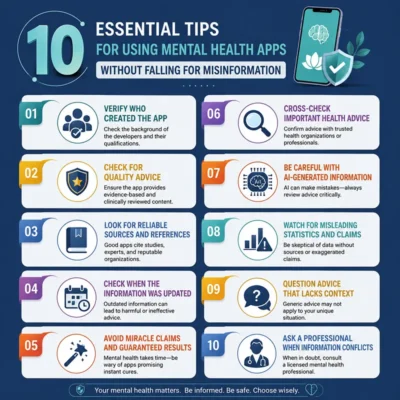
10 Essential Tips for Using Mental Health Apps Without Falling for Misinformation

Published On: June 8th, 2026|Total Views: 6|Daily Views: 1|15.5 min read|3091 words|

TABLE OF CONTENT

Do you want to know if you can benefit from the mental health apps on your smartphone? Mental health apps are now a crucial part of today’s well-being support.

A lot of people now use online platforms to manage burnout, emotional health, anxiety and stress. Individuals use different resources for different purposes, like meditation tools, mood trackers, AI chatbots and sleep apps.

To assist with your psychological or emotional well-being, many of the best apps for mental health are available. For instance, in case of any such issue, people utilise apps to practise meditation and track moods. Some people also utilise it to enhance their sleep and develop coping mechanisms.

Some professionals also use these apps to offer counselling or therapy to individuals with busy schedules or privacy concerns.

Although most people use these platforms, not every app guarantees reliability or safety.

Some programmes will make false claims or gather personal details without providing any privacy safety measures. Instead of reducing your stress, most of them may give you misleading advice that may worsen anxiety.

In contrast, if you use these apps carefully, they provide flexible tools for tackling stress, anxiety and daily issues anytime.

37% of adults in the UK used AI chatbots to help with their mental health. Most of these adults were between the ages of 25 and 34, revealing how technology is altering mental health services.

In this blog, you will explore the best tips for using mental health tools. You will also learn the risks and benefits of these digital platforms.

Key Takeaways

  • Mental health apps can help with stress, sleep, mood tracking, and daily coping skills when they are safe and evidence-based
  • The best apps for mental health are those with clear privacy rules, expert support, and tools based on CBT or mindfulness
  • Free mental health apps UK users choose should be checked for data safety, trusted reviews, and regular updates before use
  • 10 tips mental health experts suggest include limiting screen time, checking facts, avoiding harmful content, and using trusted apps only
  • Whether mental health apps work depends on the app quality, how often it is used, and whether it supports real mental health goals
  • How many mental health apps are there is hard to track exactly, but experts estimate there are now thousands available online and in app stores

What Are Mental Health Apps?

Mental health apps are online platforms where you get support for your psychological health and mental well-being. You can install them on any of your screens, such as a computer, tablet or phone.

With the aid of these apps, you can cope with tension, worry, and emotional difficulties at any time or place.

All these apps are not made for the same purpose. Some are made for mindfulness and some help in relaxation. Others can help manage anxiety, improve sleep or monitor tracks. In between sessions, some apps even help you practise handling techniques.

Individuals sometimes use mental health tools to access support resources and improve sleep. They also use it to monitor feelings, practise meditation and write thoughts.

If you are searching for help without spending money, there are several free mental health apps in the UK. On the other hand, some apps need a monthly fee. For certain conditions such as burnout, insomnia or depression, special apps are made.

Artificial intelligence (AI) is becoming increasingly widespread. With this new technology, some apps are built with chatbots that guide users through conversations. They also give thoughtful prompts.

However, specialists have given a warning to use AI tools carefully to help with well-being. You should not replace real human help or professional treatment with it.

Not all apps are secure and trustworthy. Some of them spread inaccurate advice and lack privacy protection. Some also suggest too much screen time and make illogical claims. Others may promote too much emotional addiction.

Related: Mental health diagnosis

Mental health apps should support your wellbeing, not replace real human care. The safest digital tools are those that build healthy habits, protect privacy, and encourage balance both online and offline.

Dr Emily Carter, Clinical Psychologist and Digital Wellbeing Researcher, UK 

What Are the Perks of Using Mental Health Apps?

With the aid of the best apps for mental health, you can improve your well-being. These platforms are simple to use and able to adapt. You can also fix everyday mental health issues. Some perks of mental health apps include:

Identify Your Moods

There are many apps available that help you to write in a journal or track your moods. Also, you can look back on your day. These platforms assist in finding patterns in your emotional state. With time, you can easily handle anxiety, low mood and stress.

Develop Coping Skills

Certain apps use therapy techniques such as cognitive behavioural therapy (CBT). You can stop negative thoughts and start healthy habits with the exercises given by these platforms. Others focus on better sleep, practising breathing exercises, mindfulness and relaxation.

Feel Less Lonely

Many platforms offer tips for communication and community connection. Thus, you can lessen feelings of being alone, especially during hard times.

Access Whenever You Want

You can always turn to mental health resources, regardless of where you are or what time of day. You can find many free mental health apps in the UK. You can decide when and how to use them, giving you greater control over your health.

Work While Waiting for Therapy

Some research shows that you can reduce depression symptoms and anxiety with the help of CBT-based apps. These platforms give support while you wait for professional therapy. In the middle of sessions, this serves as a link.

What Are the 10 Tips for Mental Health Apps Use?

Mental health platforms have many advantages but not all are made for the same purposes. Also, not every app provides reliable details or secure support.

If you understand how to use them, this will help you protect your online safety as well as your mental well-being.

Below are 10 tips for mental health apps that are being used:

1. Select Mental Health Apps Supported by Experts

Check out the apps created with assistance from mental health experts. These platforms are made more trustworthy by universities, hospitals and psychologists. Do not pick the ones that make assurances for quick results.

You must check carefully how it uses therapy methods such as meditation or CBT. The apps that are supported by experts pay attention to real support, privacy and safety. It does not keep you engaged only.

2. Prevent Mental Health Apps That Promise Fast Fixes

If any individual is suffering from a mental health issue, it does not get fixed so easily. It involves a great deal of attention and time. If you see an app that claims instant relief, it provides a false promise. When the platforms are reliable, they tell accurately what they cannot do and what they can do.

You must keep in mind that not every app is made for every person. If one has helped a person, it does not mean that it will also be helpful for the other.

What Are the 10 Tips for Mental Health Apps Use?

3. Review Privacy and Data Security in Mental Health Apps

When you use mental health platforms, sometimes you give sensitive details while giving sleep patterns, journals and mood logs. Therefore, before using any app, one must look at its privacy policies.

Understand well what details the platform has grabbed and who can access it. Also, know whether it has a delete option or not.

Platforms that are unclear or secretive could harm your private information. Your privacy is the initial component of emotional security.

4. Avoid Mental Health Apps Promoting Emotional Dependency

You will see that the design of some apps gives the vibe of a companion or friend. However, if you feel like this, you must not rely too much on it, as it can be harmful. You can build emotional awareness and coping skills with the help of good apps.

Remember that you can never replace these apps with real people. Always keep therapists, family or friends as human connections.

5. Think Critically About Information in Mental Health Apps

When mental health tools give you any tips or suggestions, remember that not all the info may be accurate. The chatbots of AI can confuse or oversimplify emotions.

Therefore, when it gives you some advice, you must think about whether this advice makes sense. Make sure that an expert agrees with its guidance. Beware of falling into negative online loops, such as doomscrolling.

You must compare the guidelines provided by the online app with any trustworthy source. If you find the content overwhelming, you must not follow it.

6. Look for Proven Features in Mental Health Apps

Select apps that are approved by research. Always look for the apps that use proven therapy strategies. Reliable platforms include workouts that have true advantages.

There are many fake apps that say that they are scientific but are not verified. You must make sure that the research is authentic, not just general ideas. When you gather credible evidence about the platform, you are confident that the app will assist you with it.

7. Pick Safe and Valid Mental Health Apps

Before using any app, look carefully at who has created it and how it manages your information. When the apps are trusted, it links to charities, universities and healthcare organisations.

Do not utilise platforms that have false claims. An app from a reliable source shows its limits, methods and purposes clearly. A safe app has main signs like professional backing and honesty.

8. Be Cautious With AI Chatbots in Mental Health Apps

AI chatbots can suggest coping strategies to you and guide journaling. However, remember that they are not therapists. When the platforms are good, they tell you clearly that they are just machines.

They do not ask you to develop an emotional reliance and promote offline assistance when required. You should not depend on AI to take the place of professional care or practical assistance.

9. Monitor Harmful Online Behaviour With Mental Health Apps

Your online health includes more than apps. It also covers online habits. If you doomscroll and watch negative content negatively, it increases stress a lot. In addition, it also harms your mood and affects your thinking.

You have healthy habits if you turn off unneeded alerts, limit harmful media and follow positive content. You must also take breaks while watching content. Moreover, you must think critically about digital advice and trends.

10. Use Mental Health Apps as Support Not Replacement

Apps now help with reminders, relaxation, meditation and mood tracking. However, they are not an alternative to human guidance. You should keep your lifestyle balance with community activities, offline hobbies, therapists, family and friends.

Make sure the certain app is helping you in linking with people or just making you feel alone. When these platforms provide practical support, they work best.

What Are the Risks of Using Mental Health Apps?

Mental health platforms can help you a lot with emotional health but these platforms also have many risks. These include:

Data Privacy

Most digital platforms don’t clearly mention what strategies they use to grab your personal details. They also don’t show what they gather and where they store it. The majority of them have poor privacy protections.

Due to this, sensitive mental health details become so harmful. Thus, before using any app, check its privacy policy.

Lack of Evidence

Clinical trials do not test each app. Some might make so many promises of benefits but may not deliver. Apps often use phrases like evidence-based without providing actual evidence. Due to this, sometimes users are misguided and they think that the app is so effective.

Overuse and Poor Engagement

While making some apps, developers keeps its design in a way that you can check from time to time. Due to emotional prompts or too many alerts, your screen time is increased. Your mental well-being is so much more affected than just becoming fine.

What Are the Risks of Using Mental Health Apps?

Lack of Safety Features

To reach real human help, not every app provides emergency support or ways to do so. Thus, if people are in distress, this can be dangerous. To reach rescue support, apps should always make it easy.

Fraud or Misleading Claim

Some apps violate psychological approaches or lie about what they can do. Due to this, a sense of security is not achieved. Also, this can keep you away from accurate care.

Dependency and Uncertainty

Features or apps of AI chat that look like a friend can cross established limits. If you rely too much on such apps for mood support, this will lead to dependency. For lasting health, this approach is not beneficial.
Related: Mental health misdiagnosis

Did You Know?

You do not need to hit your head to develop brain fog after an accident. Sudden neck movement from whiplash alone can affect brain and nerve function.

What Are the Best Mental Health Apps?

You will not find a single app that works for every individual issue. If you want the best apps for mental health issues, it depends on what you want to make better. Some are good for therapy support, others for mood tracking, sleep or anxiety.

This also matters in how you want to use online tools.

Mindfulness and Relaxation Apps

For stress relief, sleep support, meditation and mindfulness, Calm and Headspace are well-known apps. They are best for beginners and give easy guided tasks to help handle everyday pressure.

Another app is Insight Timer, which provides a huge library of free relaxation tools, breathing exercises and meditation content. This is one of the best free mental health apps in the UK that people can access without spending money.

CBT-Based Assistance

Some apps, such as Wysa and Woebot, offer planned exercises and conversations according to CBT. With the help of this tool, people can overcome negative thoughts and handle anxiety or low mood.

These apps give users practical coping strategies based on psychology.

Mood Analysis and Habit Building

With the help of Finch and Daylio, you can measure emotions and set up healthier ways of life over time. When you track your mood, it helps you notice patterns and take action before anxiety or a low mood worsens.

Access to Expert Support

BetterHelp is another app that links people with licensed therapists via online interaction. With the help of this, you can make continuous expert support simple to access. It is especially for users with hectic routines or restricted local choices.

These are the best apps for mental health and are safe and evidence-based. They are also easy to use and tailored to your requirements. If you can’t afford expensive ones, you can choose any free mental health apps in the UK.

Quick Tip!

Before downloading mental health apps, always check the privacy policy and see whether mental health experts helped create the app.

When to Seek Real Help Instead of Mental Health Apps?

You cannot manage every situation with the help of mental health tools. In some situations, such as trauma, emotional situations and abuse, you need real human help. Also, you can face scenarios like severe anxiety, the urge to hurt yourself or suicidal ideas.

When you use good mental health platforms, they will provide you with clear crisis details. They show phone numbers or ways to get help quickly. If the people in distress are using these apps and the platforms lack phone details, they might not be safe.

If you seek expert help, it is wise and normal. You can contact community groups, companions, family and crisis helplines. You can also reach out to counsellors, doctors or therapists.

It is also vital to see how other people are doing. Maybe you do not know and your friends and family might be having trouble. If you show them care or have a conversation with them, it can make a huge difference.

Case Study: Mental Health Support for Young People

For people aged 11 and up, Tellmi is an outstanding app. With the help of this, clients achieved confidential and safe support via text therapy and group chat.

72% of users in the UK reported feeling better after using Tellmi. For the NHS, it saved £215 per person every year.

Before this, most young individuals were facing mental health issues. People who belonged to minority groups or poor families were subject to additional hurdles and dangers. In addition, things got worse due to waiting lists.

Tellmi Helped in:

  • For a secure and private space, peer support helped
  • A link to more than 700 resources
  • With a holistic strategy, text-based therapy is used
  • For risky clients, timely counsellor support

After applying the strategy, 82% of users were able to connect with others facing similar issues. 83% of people were no longer feeling alone. As a result, the NHS became able to spend less money and reduced emergency visits and the number of doctors.

Final Thoughts

If you use mental health apps carefully, they are so beneficial. With the help of this tech, you can get support for emotional well-being, sleep, anxiety and stress.

However, you must understand that not every app is safe to use. Many are made to develop emotional dependence and promote unhealthy screen habits. Some also misuse private details and spread misinformation.

Similarly, some make bold claims without evidence or do not protect people in an emergency.

If you use such platforms safely, it takes critical thinking, balance and awareness. The tools that are most reliable, respect the user’s privacy and use proven approaches. They also promote balanced offline habits, clearly explain their limitations and provide crisis support. In addition, you will get assistance for well-being without abuse.

Concise Medico understands the need for proven and safe support. We can help provide you with apps that are combined with AI tools. Also, there is access to expert guidance to support people in handling health ethically.

Today, take care of your mental well-being. Contact us today to discover the accurate support for you and learn about trustworthy online mental health tools.

Feeling overwhelmed by mental health apps and unsure which ones you can trust?

Our team helps you create safe, research-backed digital wellbeing content that informs and protects users.
We have helped businesses and brands build trusted mental health and wellness content strategies. Reach out to us today.

Feeling overwhelmed by mental health apps and unsure which ones you can trust?

Our team helps you create safe, research-backed digital wellbeing content that informs and protects users.
We have helped businesses and brands build trusted mental health and wellness content strategies. Reach out to us today.

FAQs

Do mental health apps work?2026-06-08T06:26:42+00:00

Mental health apps can work well for some people, especially when they are based on proven methods like CBT, mindfulness, or mood tracking. They may help with stress, anxiety, sleep, and daily well-being when used correctly alongside healthy offline support.

How many mental health apps are there?2026-06-08T06:27:15+00:00

There are thousands of mental health apps available across app stores today, with experts estimating that the number continues to grow every year. These apps range from meditation and sleep tools to therapy support and AI-based wellbeing platforms.

What is the most used mental health app?2026-06-08T06:27:52+00:00

Some of the most widely used mental health apps include Calm, Headspace, BetterHelp, and Moodfit. These apps are popular because they offer meditation, sleep support, mood tracking, and therapy tools. The best option depends on your personal needs, goals, and comfort level with digital support.

Is there a free mental health app?2026-06-08T06:28:43+00:00

There are many free mental health apps available in the UK and worldwide. Some offer free meditation exercises, breathing tools, mood journals, and crisis support, while others provide paid upgrades for extra features. Always check privacy settings, expert involvement, and evidence behind the app before using it regularly.

How do I choose a mental health app?2026-06-08T06:29:15+00:00

Choose a mental health app that matches your specific needs, such as anxiety support, sleep improvement, or stress management. Look for apps with clear privacy policies, expert or clinical backing, easy navigation, and evidence-based methods like CBT or mindfulness. Reading trusted reviews and checking how recently the app was updated can also help you decide.

Share This Article!

Do you want to know if you can benefit from the mental health apps on your smartphone? Mental health apps are now a crucial part of today’s well-being support.

A lot of people now use online platforms to manage burnout, emotional health, anxiety and stress. Individuals use different resources for different purposes, like meditation tools, mood trackers, AI chatbots and sleep apps.

To assist with your psychological or emotional well-being, many of the best apps for mental health are available. For instance, in case of any such issue, people utilise apps to practise meditation and track moods. Some people also utilise it to enhance their sleep and develop coping mechanisms.

Some professionals also use these apps to offer counselling or therapy to individuals with busy schedules or privacy concerns.

Although most people use these platforms, not every app guarantees reliability or safety.

Some programmes will make false claims or gather personal details without providing any privacy safety measures. Instead of reducing your stress, most of them may give you misleading advice that may worsen anxiety.

In contrast, if you use these apps carefully, they provide flexible tools for tackling stress, anxiety and daily issues anytime.

37% of adults in the UK used AI chatbots to help with their mental health. Most of these adults were between the ages of 25 and 34, revealing how technology is altering mental health services.

In this blog, you will explore the best tips for using mental health tools. You will also learn the risks and benefits of these digital platforms.

Key Takeaways

  • Mental health apps can help with stress, sleep, mood tracking, and daily coping skills when they are safe and evidence-based
  • The best apps for mental health are those with clear privacy rules, expert support, and tools based on CBT or mindfulness
  • Free mental health apps UK users choose should be checked for data safety, trusted reviews, and regular updates before use
  • 10 tips mental health experts suggest include limiting screen time, checking facts, avoiding harmful content, and using trusted apps only
  • Whether mental health apps work depends on the app quality, how often it is used, and whether it supports real mental health goals
  • How many mental health apps are there is hard to track exactly, but experts estimate there are now thousands available online and in app stores

What Are Mental Health Apps?

Mental health apps are online platforms where you get support for your psychological health and mental well-being. You can install them on any of your screens, such as a computer, tablet or phone.

With the aid of these apps, you can cope with tension, worry, and emotional difficulties at any time or place.

All these apps are not made for the same purpose. Some are made for mindfulness and some help in relaxation. Others can help manage anxiety, improve sleep or monitor tracks. In between sessions, some apps even help you practise handling techniques.

Individuals sometimes use mental health tools to access support resources and improve sleep. They also use it to monitor feelings, practise meditation and write thoughts.

If you are searching for help without spending money, there are several free mental health apps in the UK. On the other hand, some apps need a monthly fee. For certain conditions such as burnout, insomnia or depression, special apps are made.

Artificial intelligence (AI) is becoming increasingly widespread. With this new technology, some apps are built with chatbots that guide users through conversations. They also give thoughtful prompts.

However, specialists have given a warning to use AI tools carefully to help with well-being. You should not replace real human help or professional treatment with it.

Not all apps are secure and trustworthy. Some of them spread inaccurate advice and lack privacy protection. Some also suggest too much screen time and make illogical claims. Others may promote too much emotional addiction.

Related: Mental health diagnosis

Mental health apps should support your wellbeing, not replace real human care. The safest digital tools are those that build healthy habits, protect privacy, and encourage balance both online and offline.

Dr Emily Carter, Clinical Psychologist and Digital Wellbeing Researcher, UK 

What Are the Perks of Using Mental Health Apps?

With the aid of the best apps for mental health, you can improve your well-being. These platforms are simple to use and able to adapt. You can also fix everyday mental health issues. Some perks of mental health apps include:

Identify Your Moods

There are many apps available that help you to write in a journal or track your moods. Also, you can look back on your day. These platforms assist in finding patterns in your emotional state. With time, you can easily handle anxiety, low mood and stress.

Develop Coping Skills

Certain apps use therapy techniques such as cognitive behavioural therapy (CBT). You can stop negative thoughts and start healthy habits with the exercises given by these platforms. Others focus on better sleep, practising breathing exercises, mindfulness and relaxation.

Feel Less Lonely

Many platforms offer tips for communication and community connection. Thus, you can lessen feelings of being alone, especially during hard times.

Access Whenever You Want

You can always turn to mental health resources, regardless of where you are or what time of day. You can find many free mental health apps in the UK. You can decide when and how to use them, giving you greater control over your health.

Work While Waiting for Therapy

Some research shows that you can reduce depression symptoms and anxiety with the help of CBT-based apps. These platforms give support while you wait for professional therapy. In the middle of sessions, this serves as a link.

What Are the 10 Tips for Mental Health Apps Use?

Mental health platforms have many advantages but not all are made for the same purposes. Also, not every app provides reliable details or secure support.

If you understand how to use them, this will help you protect your online safety as well as your mental well-being.

Below are 10 tips for mental health apps that are being used:

1. Select Mental Health Apps Supported by Experts

Check out the apps created with assistance from mental health experts. These platforms are made more trustworthy by universities, hospitals and psychologists. Do not pick the ones that make assurances for quick results.

You must check carefully how it uses therapy methods such as meditation or CBT. The apps that are supported by experts pay attention to real support, privacy and safety. It does not keep you engaged only.

2. Prevent Mental Health Apps That Promise Fast Fixes

If any individual is suffering from a mental health issue, it does not get fixed so easily. It involves a great deal of attention and time. If you see an app that claims instant relief, it provides a false promise. When the platforms are reliable, they tell accurately what they cannot do and what they can do.

You must keep in mind that not every app is made for every person. If one has helped a person, it does not mean that it will also be helpful for the other.

What Are the 10 Tips for Mental Health Apps Use?

3. Review Privacy and Data Security in Mental Health Apps

When you use mental health platforms, sometimes you give sensitive details while giving sleep patterns, journals and mood logs. Therefore, before using any app, one must look at its privacy policies.

Understand well what details the platform has grabbed and who can access it. Also, know whether it has a delete option or not.

Platforms that are unclear or secretive could harm your private information. Your privacy is the initial component of emotional security.

4. Avoid Mental Health Apps Promoting Emotional Dependency

You will see that the design of some apps gives the vibe of a companion or friend. However, if you feel like this, you must not rely too much on it, as it can be harmful. You can build emotional awareness and coping skills with the help of good apps.

Remember that you can never replace these apps with real people. Always keep therapists, family or friends as human connections.

5. Think Critically About Information in Mental Health Apps

When mental health tools give you any tips or suggestions, remember that not all the info may be accurate. The chatbots of AI can confuse or oversimplify emotions.

Therefore, when it gives you some advice, you must think about whether this advice makes sense. Make sure that an expert agrees with its guidance. Beware of falling into negative online loops, such as doomscrolling.

You must compare the guidelines provided by the online app with any trustworthy source. If you find the content overwhelming, you must not follow it.

6. Look for Proven Features in Mental Health Apps

Select apps that are approved by research. Always look for the apps that use proven therapy strategies. Reliable platforms include workouts that have true advantages.

There are many fake apps that say that they are scientific but are not verified. You must make sure that the research is authentic, not just general ideas. When you gather credible evidence about the platform, you are confident that the app will assist you with it.

7. Pick Safe and Valid Mental Health Apps

Before using any app, look carefully at who has created it and how it manages your information. When the apps are trusted, it links to charities, universities and healthcare organisations.

Do not utilise platforms that have false claims. An app from a reliable source shows its limits, methods and purposes clearly. A safe app has main signs like professional backing and honesty.

8. Be Cautious With AI Chatbots in Mental Health Apps

AI chatbots can suggest coping strategies to you and guide journaling. However, remember that they are not therapists. When the platforms are good, they tell you clearly that they are just machines.

They do not ask you to develop an emotional reliance and promote offline assistance when required. You should not depend on AI to take the place of professional care or practical assistance.

9. Monitor Harmful Online Behaviour With Mental Health Apps

Your online health includes more than apps. It also covers online habits. If you doomscroll and watch negative content negatively, it increases stress a lot. In addition, it also harms your mood and affects your thinking.

You have healthy habits if you turn off unneeded alerts, limit harmful media and follow positive content. You must also take breaks while watching content. Moreover, you must think critically about digital advice and trends.

10. Use Mental Health Apps as Support Not Replacement

Apps now help with reminders, relaxation, meditation and mood tracking. However, they are not an alternative to human guidance. You should keep your lifestyle balance with community activities, offline hobbies, therapists, family and friends.

Make sure the certain app is helping you in linking with people or just making you feel alone. When these platforms provide practical support, they work best.

What Are the Risks of Using Mental Health Apps?

Mental health platforms can help you a lot with emotional health but these platforms also have many risks. These include:

Data Privacy

Most digital platforms don’t clearly mention what strategies they use to grab your personal details. They also don’t show what they gather and where they store it. The majority of them have poor privacy protections.

Due to this, sensitive mental health details become so harmful. Thus, before using any app, check its privacy policy.

Lack of Evidence

Clinical trials do not test each app. Some might make so many promises of benefits but may not deliver. Apps often use phrases like evidence-based without providing actual evidence. Due to this, sometimes users are misguided and they think that the app is so effective.

Overuse and Poor Engagement

While making some apps, developers keeps its design in a way that you can check from time to time. Due to emotional prompts or too many alerts, your screen time is increased. Your mental well-being is so much more affected than just becoming fine.

What Are the Risks of Using Mental Health Apps?

Lack of Safety Features

To reach real human help, not every app provides emergency support or ways to do so. Thus, if people are in distress, this can be dangerous. To reach rescue support, apps should always make it easy.

Fraud or Misleading Claim

Some apps violate psychological approaches or lie about what they can do. Due to this, a sense of security is not achieved. Also, this can keep you away from accurate care.

Dependency and Uncertainty

Features or apps of AI chat that look like a friend can cross established limits. If you rely too much on such apps for mood support, this will lead to dependency. For lasting health, this approach is not beneficial.
Related: Mental health misdiagnosis

Did You Know?

You do not need to hit your head to develop brain fog after an accident. Sudden neck movement from whiplash alone can affect brain and nerve function.

What Are the Best Mental Health Apps?

You will not find a single app that works for every individual issue. If you want the best apps for mental health issues, it depends on what you want to make better. Some are good for therapy support, others for mood tracking, sleep or anxiety.

This also matters in how you want to use online tools.

Mindfulness and Relaxation Apps

For stress relief, sleep support, meditation and mindfulness, Calm and Headspace are well-known apps. They are best for beginners and give easy guided tasks to help handle everyday pressure.

Another app is Insight Timer, which provides a huge library of free relaxation tools, breathing exercises and meditation content. This is one of the best free mental health apps in the UK that people can access without spending money.

CBT-Based Assistance

Some apps, such as Wysa and Woebot, offer planned exercises and conversations according to CBT. With the help of this tool, people can overcome negative thoughts and handle anxiety or low mood.

These apps give users practical coping strategies based on psychology.

Mood Analysis and Habit Building

With the help of Finch and Daylio, you can measure emotions and set up healthier ways of life over time. When you track your mood, it helps you notice patterns and take action before anxiety or a low mood worsens.

Access to Expert Support

BetterHelp is another app that links people with licensed therapists via online interaction. With the help of this, you can make continuous expert support simple to access. It is especially for users with hectic routines or restricted local choices.

These are the best apps for mental health and are safe and evidence-based. They are also easy to use and tailored to your requirements. If you can’t afford expensive ones, you can choose any free mental health apps in the UK.

Quick Tip!

Before downloading mental health apps, always check the privacy policy and see whether mental health experts helped create the app.

When to Seek Real Help Instead of Mental Health Apps?

You cannot manage every situation with the help of mental health tools. In some situations, such as trauma, emotional situations and abuse, you need real human help. Also, you can face scenarios like severe anxiety, the urge to hurt yourself or suicidal ideas.

When you use good mental health platforms, they will provide you with clear crisis details. They show phone numbers or ways to get help quickly. If the people in distress are using these apps and the platforms lack phone details, they might not be safe.

If you seek expert help, it is wise and normal. You can contact community groups, companions, family and crisis helplines. You can also reach out to counsellors, doctors or therapists.

It is also vital to see how other people are doing. Maybe you do not know and your friends and family might be having trouble. If you show them care or have a conversation with them, it can make a huge difference.

Case Study: Mental Health Support for Young People

For people aged 11 and up, Tellmi is an outstanding app. With the help of this, clients achieved confidential and safe support via text therapy and group chat.

72% of users in the UK reported feeling better after using Tellmi. For the NHS, it saved £215 per person every year.

Before this, most young individuals were facing mental health issues. People who belonged to minority groups or poor families were subject to additional hurdles and dangers. In addition, things got worse due to waiting lists.

Tellmi Helped in:

  • For a secure and private space, peer support helped
  • A link to more than 700 resources
  • With a holistic strategy, text-based therapy is used
  • For risky clients, timely counsellor support

After applying the strategy, 82% of users were able to connect with others facing similar issues. 83% of people were no longer feeling alone. As a result, the NHS became able to spend less money and reduced emergency visits and the number of doctors.

Final Thoughts

If you use mental health apps carefully, they are so beneficial. With the help of this tech, you can get support for emotional well-being, sleep, anxiety and stress.

However, you must understand that not every app is safe to use. Many are made to develop emotional dependence and promote unhealthy screen habits. Some also misuse private details and spread misinformation.

Similarly, some make bold claims without evidence or do not protect people in an emergency.

If you use such platforms safely, it takes critical thinking, balance and awareness. The tools that are most reliable, respect the user’s privacy and use proven approaches. They also promote balanced offline habits, clearly explain their limitations and provide crisis support. In addition, you will get assistance for well-being without abuse.

Concise Medico understands the need for proven and safe support. We can help provide you with apps that are combined with AI tools. Also, there is access to expert guidance to support people in handling health ethically.

Today, take care of your mental well-being. Contact us today to discover the accurate support for you and learn about trustworthy online mental health tools.

Feeling overwhelmed by mental health apps and unsure which ones you can trust?

Our team helps you create safe, research-backed digital wellbeing content that informs and protects users.
We have helped businesses and brands build trusted mental health and wellness content strategies. Reach out to us today.

Feeling overwhelmed by mental health apps and unsure which ones you can trust?

Our team helps you create safe, research-backed digital wellbeing content that informs and protects users.
We have helped businesses and brands build trusted mental health and wellness content strategies. Reach out to us today.

FAQs

Do mental health apps work?2026-06-08T06:26:42+00:00

Mental health apps can work well for some people, especially when they are based on proven methods like CBT, mindfulness, or mood tracking. They may help with stress, anxiety, sleep, and daily well-being when used correctly alongside healthy offline support.

How many mental health apps are there?2026-06-08T06:27:15+00:00

There are thousands of mental health apps available across app stores today, with experts estimating that the number continues to grow every year. These apps range from meditation and sleep tools to therapy support and AI-based wellbeing platforms.

What is the most used mental health app?2026-06-08T06:27:52+00:00

Some of the most widely used mental health apps include Calm, Headspace, BetterHelp, and Moodfit. These apps are popular because they offer meditation, sleep support, mood tracking, and therapy tools. The best option depends on your personal needs, goals, and comfort level with digital support.

Is there a free mental health app?2026-06-08T06:28:43+00:00

There are many free mental health apps available in the UK and worldwide. Some offer free meditation exercises, breathing tools, mood journals, and crisis support, while others provide paid upgrades for extra features. Always check privacy settings, expert involvement, and evidence behind the app before using it regularly.

How do I choose a mental health app?2026-06-08T06:29:15+00:00

Choose a mental health app that matches your specific needs, such as anxiety support, sleep improvement, or stress management. Look for apps with clear privacy policies, expert or clinical backing, easy navigation, and evidence-based methods like CBT or mindfulness. Reading trusted reviews and checking how recently the app was updated can also help you decide.

Go to Top