TABLE OF CONTENT
- Key Takeaways
- What Is a Neurological Disorder?
- What Are the Types of Neurological Disorders Relevant to Compensation Claims?
- What Are Common Neurological Symptoms?
- Why Are Neurological Symptoms So Hard to Prove?
- How Neurological Symptoms Affect Compensation?
- How to Build a Strong Claim?
- What are the Special Considerations for FND Claims?
- What are Workplace Neurological Injuries?
- What Is the Role of a Specialist Solicitor?
- Real Life Example
- Conclusion
- FAQs
Neurological Symptoms and Disorders That Can Affect Compensation Claims
Being in an accident is scary enough. But what happens when things still feel wrong weeks later? Neurological symptoms like headaches, memory loss, tremors and muscle weakness can creep in after trauma and slowly take over your life. There is a condition that causes exactly these kinds of symptoms. It is called Functional Neurological Disorder or FND. Recent studies show that Functional Neurological Disorder or FND affects a lot of people. It affects between 50,000 and 100,000 people in the United Kingdom. This highlights that people can have serious neurological symptoms after trauma or stress.
The trouble is, these symptoms are often the hardest ones to prove in a legal claim. Insurers and defendants frequently dismiss them, especially when they cannot be seen on a standard scan. If you have been dealing with neurological disorders after an accident that was not your fault, you need to know your rights.
What Is a Neurological Disorder?
A neurological disorder is any condition caused by damage or disease to the nervous system. The nervous system includes your brain, spinal cord and all the nerves in your body. When any part of this system is damaged, the effects can be serious and wide-ranging.
Neurological disorder symptoms vary a lot depending on where the damage is and how bad it is. Some conditions are mild. Others are life-changing. Some people lose the ability to work, drive or even look after themselves.
These disorders are usually grouped in three ways:
- By location: such as brain, spinal cord or nerve damage
- By the type of problem they cause, for example brain conditions can affect language (aphasia), writing (dysgraphia), speech (dysarthria), memory (amnesia), movement (apraxia) or the ability to recognise people and objects (agnosia)
- By the cause of the condition.
Other recognised types include seizure disorders, sleep disorders, movement disorders, migraines, lower back and neck pain and neuropsychiatric conditions like ADHD and autism.
What Are the Types of Neurological Disorders Relevant to Compensation Claims?
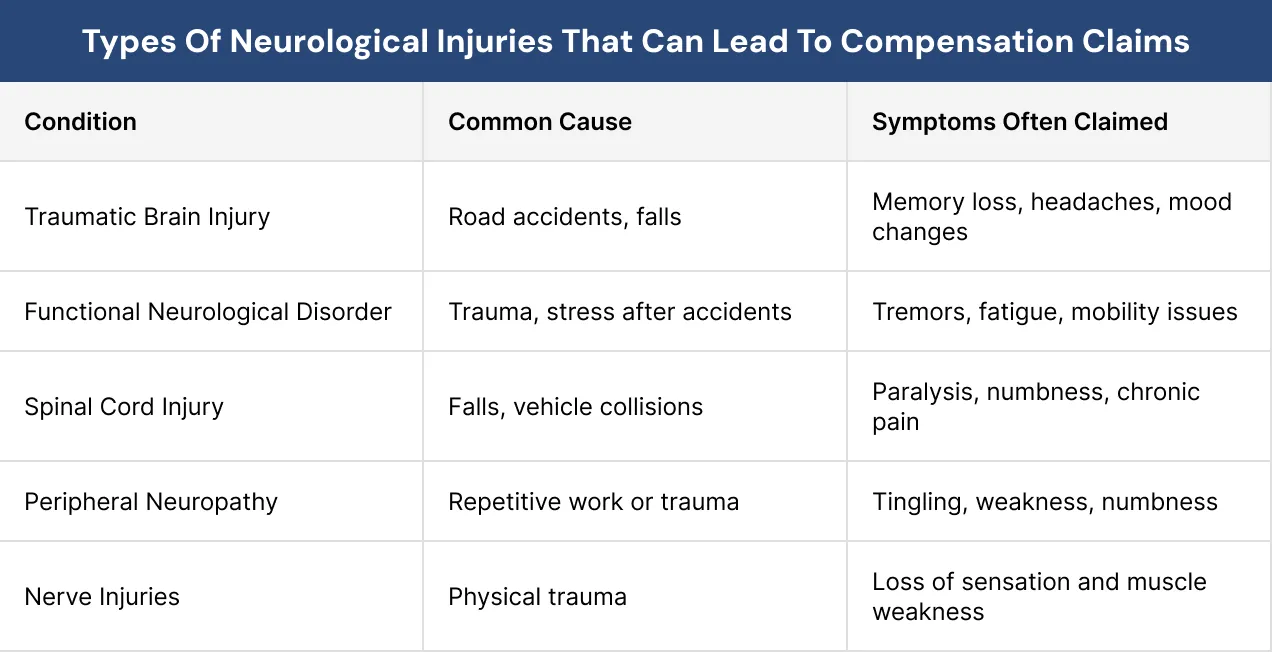
Not every neurological condition leads to a compensation claim. But many do, especially when they develop after an accident caused by someone else’s negligence. Here are the most relevant types.
1. Traumatic Brain Injuries (TBI)
A traumatic brain injury happens when a sudden impact disrupts normal brain function. In workplace accidents, TBIs often happen because of falls from height, objects hitting the head or vehicle collisions during work travel. They are one of the most common serious injuries claimed for in road accidents. A 2025 UK road safety report found that road rage incidents went up by 34% between 2021 and 2025. This led to thousands of injuries on British roads.
What makes TBIs tricky is that neurological symptoms do not always show up straight away. After a knock to the head, a person might feel a bit off but assume it will pass. Days or weeks later, symptoms can get much worse. Persistent headaches, memory problems, mood changes, sleep issues and sensitivity to light are all common signs.
The long-term effects of a TBI can be severe. Memory loss, personality changes and physical disabilities can make it very hard to return to work or keep up with daily life.
2. Spinal Cord Injuries
Spinal cord injuries are also classed as neurological disorders. They can range from partial to full loss of function below the point of injury. Falls, vehicle collisions and workplace accidents are common causes. Depending on severity, they can lead to paralysis, loss of sensation or long-term mobility problems.
3. Functional Neurological Disorder (FND)
FND is one of the most misunderstood conditions in personal injury law. It causes real and serious neurological symptoms including mobility problems, fatigue, tremors, speech difficulties and memory loss. But it cannot be confirmed through standard brain scans. This makes it hard to prove and easy for insurers to dispute. We cover FND in more detail later in this blog.
Symptoms are real, common and potentially reversible with treatment.
– Professor Jon Stone, Professor of Neurology at the University of Edinburgh
4. Peripheral Neuropathy and Nerve Injuries
Nerve injuries involve damage to the nerves outside the brain and spinal cord. They can result from repetitive work tasks, harmful chemical exposure or physical trauma. Common symptoms include numbness, tingling and weakness in the arms and legs. At one end, conditions like carpal tunnel syndrome are manageable. At the other end, severe nerve damage can be permanent.
What Are Common Neurological Symptoms?
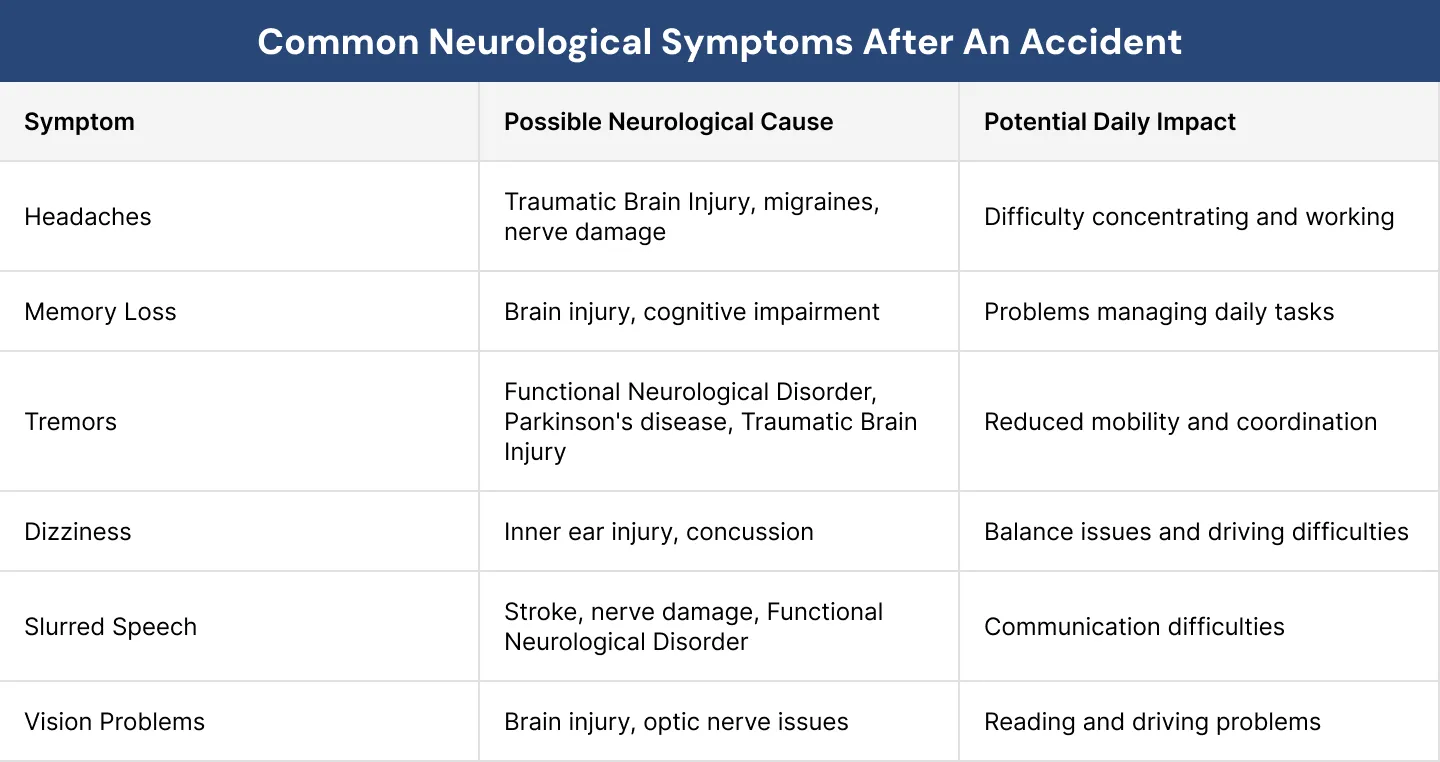
Neurological symptoms are the signals your body sends when something is wrong with the nervous system.They can show up suddenly or build up slowly over time. Some are obvious right away while others are easy to miss. This makes them hard to deal with, both medically and legally.
1. Headaches
Headaches are one of the most common neurological symptoms after an accident. They are classed as either primary where the headache itself is the condition or secondary, where they are caused by something else. That something else could be a migraine, a head injury, a brain tumour, eye strain or neck and back tension. If your headaches are severe or keep coming back after an accident, always see a neurologist.
2. Muscle Weakness
Muscle weakness is when your muscles do not perform at full strength, even when you try your hardest. It is more than just feeling tired. If it persists, it could point to conditions like multiple sclerosis, ALS, stroke, herniated disk, chronic fatigue syndrome, neuralgia or peripheral neuropathy. All of these can support a neurology compensation claim if caused by an accident.
3. Seizures
A seizure is a sudden electrical disturbance in the brain. It can cause changes in behaviour, movement, feeling or consciousness. The type and severity depend on where in the brain it starts. Recurring seizures may indicate epilepsy. Other causes include stroke, brain tumours and head trauma, all of which can be linked to accidents.
4. Impaired Sensation
Impaired sensation means feeling numbness or a complete loss of feeling in part of your body. This can follow a physical injury but is also a known neurological symptom. Head injuries, strokes, brain tumours and peripheral neuropathy are common causes.
5. Dizziness
Dizziness can feel like faintness, unsteadiness or a spinning sensation called vertigo. It is a very common neurological symptom after accidents. It can be linked to migraines, inner ear problems, medication side effects and nervous system conditions. Many people ignore it and hope it passes. But if it persists, it needs medical attention and could support your claim.
6. Tremors
Tremors are involuntary, rhythmic movements of the hands, arms, legs or other body parts. They can come and go through the day and may get worse over time. Conditions linked to tremors include stroke, multiple sclerosis, Parkinson’s disease and traumatic brain injury. When tremors start or worsen after an accident, they can form a key part of a compensation claim.
7. Slurred Speech
Slurred speech includes mumbling, poor pronunciation or changes in how fast or rhythmically someone speaks. Beyond alcohol or drugs, it can be caused by ALS, MS, Bell’s palsy, cerebral palsy, muscular dystrophy or Parkinson’s disease. This is a neurological symptom that should never be dismissed after an accident or medical event.
8. Cognitive Impairment
Cognitive impairment means a noticeable drop in thinking, memory, judgment or language skills. Some decline is normal with age. But when it appears after an accident, it can point to conditions like dementia, Alzheimer’s disease, depression, head injury or a brain tumour. This type of neurological symptom can seriously affect someone’s ability to work and manage daily life.
9. Vision Problems
Not all vision problems come from the eyes. Some are neurological symptoms that come from the nervous system. Blurred vision, light sensitivity, reduced vision and spotty or disrupted sight can be linked to migraines, multiple sclerosis, brain tumours, optic neuropathy, Parkinson’s disease and Alzheimer’s disease. After an accident, vision problems should always be assessed as part of a wider neurological check.
Why Are Neurological Symptoms So Hard to Prove?
Here is the uncomfortable truth. Having real, debilitating neurological symptoms does not mean your claim will be easy. In fact, these cases are often the most disputed.
The biggest problem is that many neurological symptoms are invisible. They do not always show up on a brain scan. They cannot always be measured with a standard test. This gives insurers and defendants room to push back. They may say the symptoms have another cause. They may claim the symptoms are exaggerated or they may argue that a pre-existing condition means the accident only triggered something rather than caused it.
The fluctuating nature of neurological disorder symptoms makes things even harder. Conditions like FND have good days and bad days. A claimant might seem relatively well at one appointment and much worse at another. Defendants use this against claimants even though this variability is completely normal for these conditions.
Think about cognitive impairment. It can be subtle and easy to dismiss. Dizziness and fatigue are symptoms people push through rather than report. Tremors come and go. Slurred speech may only appear when someone is tired or under stress. All of these features are medically normal and can become a point of attack in a legal dispute.
Proving neurological disorder symptoms fully often requires expert medical evaluations, neuropsychological assessments and statements from family members or colleagues. These people can speak to the real changes they have seen in the person’s behaviour and daily function. Without all of this, a claim can easily be undervalued or rejected.
How Neurological Symptoms Affect Compensation?
The financial impact of neurological symptoms after an accident can be huge. Someone who was once independent and working full time may now be unable to drive, hold down a job or care for themselves properly.
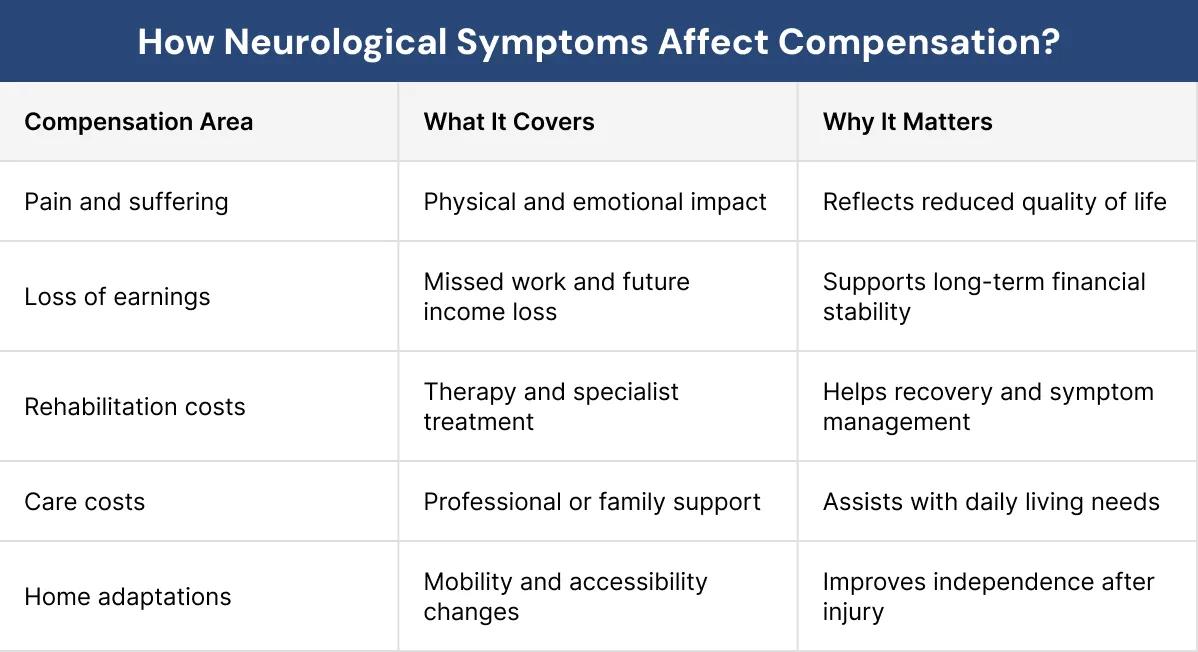
When it comes to neurology compensation, claims usually cover these key areas:
- Pain and suffering cover the physical and emotional distress the condition has caused.
- Past and future loss of earnings reflects the reality that many neurological conditions affect the ability to work, sometimes permanently.
- Rehabilitation and treatment costs cover things like physiotherapy, psychological therapy and specialist treatment.
- Home and vehicle adaptations may be needed when mobility or independence has been affected.
- Care costs cover the ongoing support needed, whether from a paid carer or a family member.
In serious cases, particularly TBIs or FND, neurology compensation settlements can be very significant. Six-figure sums are not uncommon. According to UK research from general neurology clinics, around 40% of people with FND improve within a year but for others, the condition becomes long-term or permanent. This uncertainty makes valuing claims complex and it needs expert handling.
How to Build a Strong Claim?
A diagnosis on its own is not enough to win a compensation claim involving neurological symptoms. You need a carefully built case with solid evidence.
Medical records and GP notes show what your health was like before the accident. Employment history, payslips and statements from family and colleagues show how your life has changed since. This is all essential for countering the common argument that your symptoms would have developed anyway.
Specialist medical experts are not optional, rather they are essential. For FND, you need neurologists and neuropsychiatrists who can make a positive diagnosis based on clinical signs. Standard scans will not show FND. Experts need to assess both the neurological and psychiatric sides of a condition together. Only then does the full picture emerge.
Interim payments can often be secured early on, even before liability is admitted. This is done under the Rehabilitation Code. It means treatment and rehabilitation can start right away. Early engagement with specialist therapy makes a real difference to outcomes. For FND especially, if someone does not accept their diagnosis or engage with treatment, their long-term prognosis is likely to be much worse.
What are the Special Considerations for FND Claims?
FND sits at the sharpest end of the challenge that neurological symptoms present in compensation claims. It is worth looking at it in more detail.
FND is real. It causes genuinely debilitating neurological symptoms like mobility problems, fatigue, tremors, speech difficulties, confusion and memory loss. These symptoms can destroy a person’s independence, relationships and ability to work. They may appear suddenly after a stressful event or following physical or emotional trauma.
According to the Mayo Clinic, women are more likely than men to develop FND. The risk also goes up if the person already has another neurological condition.
What makes FND claims so demanding is proving the causation chain. Legal and medical experts must work together to show how the specific circumstances of the accident – the impact, the fear and the aftermath created the conditions for FND to develop. Research shows that FND can be triggered by relatively minor trauma in people who are susceptible. This directly counters the common argument that a minor accident cannot have caused such serious neurological symptoms.
Defendants will often argue that symptom fluctuation, the good days and bad days shows that condition is not genuine. But variability is a recognised and well-documented feature of FND. It is not a sign of dishonesty.
Early diagnosis and clear communication matter a lot. If someone with FND does not understand or accept their diagnosis, they are unlikely to engage with the treatment that gives them the best chance of improvement. Getting the right medical and legal team in place early is crucial.
What are Workplace Neurological Injuries?
Neurological symptoms do not only follow road accidents. Many people sustain neurological injuries at work and these cases have their own rules.
Common causes include falls from height, objects hitting the head, slipping on wet floors and vehicle collisions during work travel. Repetitive tasks can lead to carpal tunnel syndrome. Exposure to toxic chemicals can cause peripheral neuropathy, leading to numbness and tingling in the limbs.
The legal standard for proving a workplace neurological injury is different from a standard personal injury claim. An employee does not need to prove that their employer was negligent. They only need to show the injury happened during the course of their employment. However, if the cause is not obvious, insurers will often dispute it. In those cases, legal investigation and expert medical opinion are key.
Benefits available in workplace neurological injury claims usually include the full cost of medical treatment, travel costs to and from appointments and disability benefits when the person cannot work. Temporary disability benefits are generally available for up to 104 weeks. If the person cannot return to their old role, they may also qualify for retraining support to help them move into a new type of work.
If a third party rather than the employer caused the neurological injury, a personal injury claim may also be possible. This can add compensation for pain and suffering and loss of quality of life. These are things that workers’ compensation alone does not cover.
What Is the Role of a Specialist Solicitor?
Pursuing a claim involving neurological symptoms is not something to do without the right support. The medical complexity is significant. Add the scepticism of insurers, the need for expert witnesses and the emotional toll of living with a serious condition. It is clear why specialist legal help matters so much.
A specialist solicitor will make sure the right medical experts are brought in from the start. They will gather the evidence needed to build a strong case. They will handle negotiations with insurers who want to pay as little as possible. And where needed, they will take further legal action.
Good solicitors also understand what it is like to live with neurological disorder symptoms day to day. These conditions affect concentration, energy and cognitive function. A good legal team will explain things clearly and at your pace. They will offer flexible meeting options. And they will not make you feel bad if you need to cancel at short notice because of a flare-up.
Most neurological injury and neurology compensation claims are run on a No Win, No Fee basis. This means no upfront costs and no charge if the claim does not succeed. You can pursue the compensation you deserve without any financial risk.
Real Life Example
A UK case involved a person who got severe Functional Neurological Disorder symptoms after a road crash that first seemed minor. The other driver accepted fault for the crash. Later, the person began to have shaking, trouble walking and other serious nerve symptoms. Doctors could not clearly show the cause on normal scans.
The case became a big dispute because the insurance company said the symptoms seemed far worse than the first injuries. Medical experts were asked to look at both the nerve problems and mental health side of the condition.
The main question was whether the crash caused the person’s FND and how much it harmed their daily life and future ability to work. The case shows that nerve injury claims can become very complex, especially when symptoms change over time or do not appear clearly on scans.
Conclusion
Living with neurological symptoms after an accident is hard. The condition is real. The impact is real. The financial consequences are real. Even if no one else can see what you are going through.
Whether you have persistent headaches, memory problems, tremors or a formal diagnosis of something more complex, you have the right to claim compensation that reflects your true losses. Neurological disorder symptoms are taken seriously in law but only when they are presented with the right evidence, the right experts and the right legal team.
Neurology compensation claims take time and specialist knowledge. The sooner you get advice, the sooner you can start rebuilding your life. Do not wait for things to get worse. Find a solicitor who understands neurological conditions, make sure your experience is heard and your losses are fully recognised.
Concise Medico understands how challenging neurological injury claims can be, especially when neurological symptoms are invisible, delayed or difficult to prove. If you need expert medico-legal support for neurological injury cases, contact us today to discuss how our specialists can help.
FAQs
Neurological Symptoms and Disorders That Can Affect Compensation Claims
Being in an accident is scary enough. But what happens when things still feel wrong weeks later? Neurological symptoms like headaches, memory loss, tremors and muscle weakness can creep in after trauma and slowly take over your life. There is a condition that causes exactly these kinds of symptoms. It is called Functional Neurological Disorder or FND. Recent studies show that Functional Neurological Disorder or FND affects a lot of people. It affects between 50,000 and 100,000 people in the United Kingdom. This highlights that people can have serious neurological symptoms after trauma or stress.
The trouble is, these symptoms are often the hardest ones to prove in a legal claim. Insurers and defendants frequently dismiss them, especially when they cannot be seen on a standard scan. If you have been dealing with neurological disorders after an accident that was not your fault, you need to know your rights.
What Is a Neurological Disorder?
A neurological disorder is any condition caused by damage or disease to the nervous system. The nervous system includes your brain, spinal cord and all the nerves in your body. When any part of this system is damaged, the effects can be serious and wide-ranging.
Neurological disorder symptoms vary a lot depending on where the damage is and how bad it is. Some conditions are mild. Others are life-changing. Some people lose the ability to work, drive or even look after themselves.
These disorders are usually grouped in three ways:
- By location: such as brain, spinal cord or nerve damage
- By the type of problem they cause, for example brain conditions can affect language (aphasia), writing (dysgraphia), speech (dysarthria), memory (amnesia), movement (apraxia) or the ability to recognise people and objects (agnosia)
- By the cause of the condition.
Other recognised types include seizure disorders, sleep disorders, movement disorders, migraines, lower back and neck pain and neuropsychiatric conditions like ADHD and autism.
What Are the Types of Neurological Disorders Relevant to Compensation Claims?
Not every neurological condition leads to a compensation claim. But many do, especially when they develop after an accident caused by someone else’s negligence. Here are the most relevant types.
1. Traumatic Brain Injuries (TBI)
A traumatic brain injury happens when a sudden impact disrupts normal brain function. In workplace accidents, TBIs often happen because of falls from height, objects hitting the head or vehicle collisions during work travel. They are one of the most common serious injuries claimed for in road accidents. A 2025 UK road safety report found that road rage incidents went up by 34% between 2021 and 2025. This led to thousands of injuries on British roads.
What makes TBIs tricky is that neurological symptoms do not always show up straight away. After a knock to the head, a person might feel a bit off but assume it will pass. Days or weeks later, symptoms can get much worse. Persistent headaches, memory problems, mood changes, sleep issues and sensitivity to light are all common signs.
The long-term effects of a TBI can be severe. Memory loss, personality changes and physical disabilities can make it very hard to return to work or keep up with daily life.
2. Spinal Cord Injuries
Spinal cord injuries are also classed as neurological disorders. They can range from partial to full loss of function below the point of injury. Falls, vehicle collisions and workplace accidents are common causes. Depending on severity, they can lead to paralysis, loss of sensation or long-term mobility problems.
3. Functional Neurological Disorder (FND)
FND is one of the most misunderstood conditions in personal injury law. It causes real and serious neurological symptoms including mobility problems, fatigue, tremors, speech difficulties and memory loss. But it cannot be confirmed through standard brain scans. This makes it hard to prove and easy for insurers to dispute. We cover FND in more detail later in this blog.
Symptoms are real, common and potentially reversible with treatment.
– Professor Jon Stone, Professor of Neurology at the University of Edinburgh
4. Peripheral Neuropathy and Nerve Injuries
Nerve injuries involve damage to the nerves outside the brain and spinal cord. They can result from repetitive work tasks, harmful chemical exposure or physical trauma. Common symptoms include numbness, tingling and weakness in the arms and legs. At one end, conditions like carpal tunnel syndrome are manageable. At the other end, severe nerve damage can be permanent.

What Are Common Neurological Symptoms?
Neurological symptoms are the signals your body sends when something is wrong with the nervous system.They can show up suddenly or build up slowly over time. Some are obvious right away while others are easy to miss. This makes them hard to deal with, both medically and legally.
1. Headaches
Headaches are one of the most common neurological symptoms after an accident. They are classed as either primary where the headache itself is the condition or secondary, where they are caused by something else. That something else could be a migraine, a head injury, a brain tumour, eye strain or neck and back tension. If your headaches are severe or keep coming back after an accident, always see a neurologist.
2. Muscle Weakness
Muscle weakness is when your muscles do not perform at full strength, even when you try your hardest. It is more than just feeling tired. If it persists, it could point to conditions like multiple sclerosis, ALS, stroke, herniated disk, chronic fatigue syndrome, neuralgia or peripheral neuropathy. All of these can support a neurology compensation claim if caused by an accident.
3. Seizures
A seizure is a sudden electrical disturbance in the brain. It can cause changes in behaviour, movement, feeling or consciousness. The type and severity depend on where in the brain it starts. Recurring seizures may indicate epilepsy. Other causes include stroke, brain tumours and head trauma, all of which can be linked to accidents.
4. Impaired Sensation
Impaired sensation means feeling numbness or a complete loss of feeling in part of your body. This can follow a physical injury but is also a known neurological symptom. Head injuries, strokes, brain tumours and peripheral neuropathy are common causes.
5. Dizziness
Dizziness can feel like faintness, unsteadiness or a spinning sensation called vertigo. It is a very common neurological symptom after accidents. It can be linked to migraines, inner ear problems, medication side effects and nervous system conditions. Many people ignore it and hope it passes. But if it persists, it needs medical attention and could support your claim.
6. Tremors
Tremors are involuntary, rhythmic movements of the hands, arms, legs or other body parts. They can come and go through the day and may get worse over time. Conditions linked to tremors include stroke, multiple sclerosis, Parkinson’s disease and traumatic brain injury. When tremors start or worsen after an accident, they can form a key part of a compensation claim.
7. Slurred Speech
Slurred speech includes mumbling, poor pronunciation or changes in how fast or rhythmically someone speaks. Beyond alcohol or drugs, it can be caused by ALS, MS, Bell’s palsy, cerebral palsy, muscular dystrophy or Parkinson’s disease. This is a neurological symptom that should never be dismissed after an accident or medical event.
8. Cognitive Impairment
Cognitive impairment means a noticeable drop in thinking, memory, judgment or language skills. Some decline is normal with age. But when it appears after an accident, it can point to conditions like dementia, Alzheimer’s disease, depression, head injury or a brain tumour. This type of neurological symptom can seriously affect someone’s ability to work and manage daily life.
9. Vision Problems
Not all vision problems come from the eyes. Some are neurological symptoms that come from the nervous system. Blurred vision, light sensitivity, reduced vision and spotty or disrupted sight can be linked to migraines, multiple sclerosis, brain tumours, optic neuropathy, Parkinson’s disease and Alzheimer’s disease. After an accident, vision problems should always be assessed as part of a wider neurological check.

Why Are Neurological Symptoms So Hard to Prove?
Here is the uncomfortable truth. Having real, debilitating neurological symptoms does not mean your claim will be easy. In fact, these cases are often the most disputed.
The biggest problem is that many neurological symptoms are invisible. They do not always show up on a brain scan. They cannot always be measured with a standard test. This gives insurers and defendants room to push back. They may say the symptoms have another cause. They may claim the symptoms are exaggerated or they may argue that a pre-existing condition means the accident only triggered something rather than caused it.
The fluctuating nature of neurological disorder symptoms makes things even harder. Conditions like FND have good days and bad days. A claimant might seem relatively well at one appointment and much worse at another. Defendants use this against claimants even though this variability is completely normal for these conditions.
Think about cognitive impairment. It can be subtle and easy to dismiss. Dizziness and fatigue are symptoms people push through rather than report. Tremors come and go. Slurred speech may only appear when someone is tired or under stress. All of these features are medically normal and can become a point of attack in a legal dispute.
Proving neurological disorder symptoms fully often requires expert medical evaluations, neuropsychological assessments and statements from family members or colleagues. These people can speak to the real changes they have seen in the person’s behaviour and daily function. Without all of this, a claim can easily be undervalued or rejected.
How Neurological Symptoms Affect Compensation?
The financial impact of neurological symptoms after an accident can be huge. Someone who was once independent and working full time may now be unable to drive, hold down a job or care for themselves properly.
When it comes to neurology compensation, claims usually cover these key areas:
- Pain and suffering cover the physical and emotional distress the condition has caused.
- Past and future loss of earnings reflects the reality that many neurological conditions affect the ability to work, sometimes permanently.
- Rehabilitation and treatment costs cover things like physiotherapy, psychological therapy and specialist treatment.
- Home and vehicle adaptations may be needed when mobility or independence has been affected.
- Care costs cover the ongoing support needed, whether from a paid carer or a family member.

In serious cases, particularly TBIs or FND, neurology compensation settlements can be very significant. Six-figure sums are not uncommon. According to UK research from general neurology clinics, around 40% of people with FND improve within a year but for others, the condition becomes long-term or permanent. This uncertainty makes valuing claims complex and it needs expert handling.
How to Build a Strong Claim?
A diagnosis on its own is not enough to win a compensation claim involving neurological symptoms. You need a carefully built case with solid evidence.
Medical records and GP notes show what your health was like before the accident. Employment history, payslips and statements from family and colleagues show how your life has changed since. This is all essential for countering the common argument that your symptoms would have developed anyway.
Specialist medical experts are not optional, rather they are essential. For FND, you need neurologists and neuropsychiatrists who can make a positive diagnosis based on clinical signs. Standard scans will not show FND. Experts need to assess both the neurological and psychiatric sides of a condition together. Only then does the full picture emerge.
Interim payments can often be secured early on, even before liability is admitted. This is done under the Rehabilitation Code. It means treatment and rehabilitation can start right away. Early engagement with specialist therapy makes a real difference to outcomes. For FND especially, if someone does not accept their diagnosis or engage with treatment, their long-term prognosis is likely to be much worse.
What are the Special Considerations for FND Claims?
FND sits at the sharpest end of the challenge that neurological symptoms present in compensation claims. It is worth looking at it in more detail.
FND is real. It causes genuinely debilitating neurological symptoms like mobility problems, fatigue, tremors, speech difficulties, confusion and memory loss. These symptoms can destroy a person’s independence, relationships and ability to work. They may appear suddenly after a stressful event or following physical or emotional trauma.
According to the Mayo Clinic, women are more likely than men to develop FND. The risk also goes up if the person already has another neurological condition.
What makes FND claims so demanding is proving the causation chain. Legal and medical experts must work together to show how the specific circumstances of the accident – the impact, the fear and the aftermath created the conditions for FND to develop. Research shows that FND can be triggered by relatively minor trauma in people who are susceptible. This directly counters the common argument that a minor accident cannot have caused such serious neurological symptoms.
Defendants will often argue that symptom fluctuation, the good days and bad days shows that condition is not genuine. But variability is a recognised and well-documented feature of FND. It is not a sign of dishonesty.
Early diagnosis and clear communication matter a lot. If someone with FND does not understand or accept their diagnosis, they are unlikely to engage with the treatment that gives them the best chance of improvement. Getting the right medical and legal team in place early is crucial.
What are Workplace Neurological Injuries?
Neurological symptoms do not only follow road accidents. Many people sustain neurological injuries at work and these cases have their own rules.
Common causes include falls from height, objects hitting the head, slipping on wet floors and vehicle collisions during work travel. Repetitive tasks can lead to carpal tunnel syndrome. Exposure to toxic chemicals can cause peripheral neuropathy, leading to numbness and tingling in the limbs.
The legal standard for proving a workplace neurological injury is different from a standard personal injury claim. An employee does not need to prove that their employer was negligent. They only need to show the injury happened during the course of their employment. However, if the cause is not obvious, insurers will often dispute it. In those cases, legal investigation and expert medical opinion are key.
Benefits available in workplace neurological injury claims usually include the full cost of medical treatment, travel costs to and from appointments and disability benefits when the person cannot work. Temporary disability benefits are generally available for up to 104 weeks. If the person cannot return to their old role, they may also qualify for retraining support to help them move into a new type of work.
If a third party rather than the employer caused the neurological injury, a personal injury claim may also be possible. This can add compensation for pain and suffering and loss of quality of life. These are things that workers’ compensation alone does not cover.
What Is the Role of a Specialist Solicitor?
Pursuing a claim involving neurological symptoms is not something to do without the right support. The medical complexity is significant. Add the scepticism of insurers, the need for expert witnesses and the emotional toll of living with a serious condition. It is clear why specialist legal help matters so much.
A specialist solicitor will make sure the right medical experts are brought in from the start. They will gather the evidence needed to build a strong case. They will handle negotiations with insurers who want to pay as little as possible. And where needed, they will take further legal action.
Good solicitors also understand what it is like to live with neurological disorder symptoms day to day. These conditions affect concentration, energy and cognitive function. A good legal team will explain things clearly and at your pace. They will offer flexible meeting options. And they will not make you feel bad if you need to cancel at short notice because of a flare-up.
Most neurological injury and neurology compensation claims are run on a No Win, No Fee basis. This means no upfront costs and no charge if the claim does not succeed. You can pursue the compensation you deserve without any financial risk.
Real Life Example
A UK case involved a person who got severe Functional Neurological Disorder symptoms after a road crash that first seemed minor. The other driver accepted fault for the crash. Later, the person began to have shaking, trouble walking and other serious nerve symptoms. Doctors could not clearly show the cause on normal scans.
The case became a big dispute because the insurance company said the symptoms seemed far worse than the first injuries. Medical experts were asked to look at both the nerve problems and mental health side of the condition.
The main question was whether the crash caused the person’s FND and how much it harmed their daily life and future ability to work. The case shows that nerve injury claims can become very complex, especially when symptoms change over time or do not appear clearly on scans.
Conclusion
Living with neurological symptoms after an accident is hard. The condition is real. The impact is real. The financial consequences are real. Even if no one else can see what you are going through.
Whether you have persistent headaches, memory problems, tremors or a formal diagnosis of something more complex, you have the right to claim compensation that reflects your true losses. Neurological disorder symptoms are taken seriously in law but only when they are presented with the right evidence, the right experts and the right legal team.
Neurology compensation claims take time and specialist knowledge. The sooner you get advice, the sooner you can start rebuilding your life. Do not wait for things to get worse. Find a solicitor who understands neurological conditions, make sure your experience is heard and your losses are fully recognised.
Concise Medico understands how challenging neurological injury claims can be, especially when neurological symptoms are invisible, delayed or difficult to prove. If you need expert medico-legal support for neurological injury cases, contact us today to discuss how our specialists can help.