TABLE OF CONTENT
The Role of a Pain Management Expert Witness in Personal Injury Claims
What happens if someone experiences pain long after an accident even if the injury has healed?
For some people, such pain becomes a chronic condition that could affect their sleep, limit daily tasks and their ability to go to work. In the UK, about one in four adults suffer from chronic pain, showing how common this condition is.
However, it may be hard to prove chronic pain in personal injury cases since it doesn’t always show up in scans or other medical tests.
In such cases, a pain management expert witness plays an important role. A pain management medical legal expert witness helps the court in such cases to explain a person’s pain, its cause, and how it affects their daily life. The expert reviews medical history, finds the link between the accident and the pain and gives an independent medical view through a report. That report explains the severity of pain, required treatment, recovery period and the chance of future problems from the injury.
Who Is a Pain Management Expert Witness in Personal Injury Cases?
A pain management expert witness in personal injury cases is a medical professional expert in anaesthesia or neurology. They check the condition of chronic pain that occurs after the injury. They provide an independent report about the impact of pain on the person’s daily tasks.
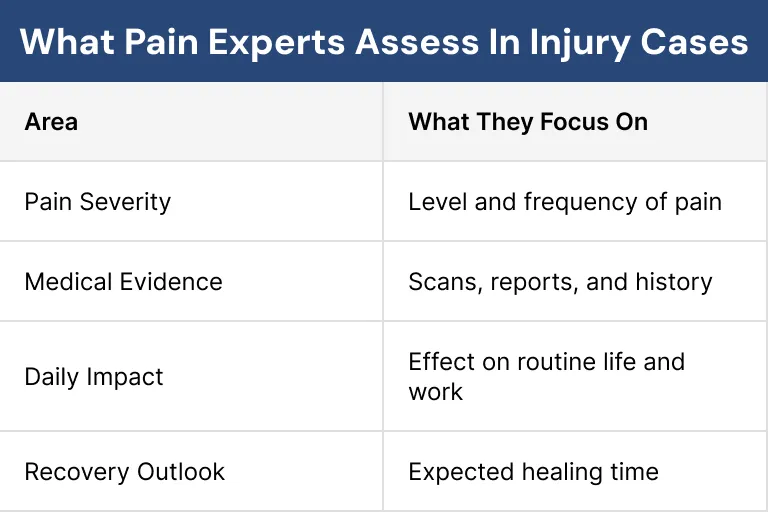
What Is the Role of a Pain Management Expert Witness in Personal Injury Cases?
The role of a pain management expert witness in personal injury cases provides expert medical evidence to help courts get an understanding of the pain. They analyse the condition of the claimant and explain to the court how injury is impacting the person’s daily life.
The main responsibilities of pain management expert witness includes:
-
Finding the Cause of Pain
They check if the accident caused the pain or made an old condition worse. They review the medical records and symptoms. This helps show the exact reason for the pain.
-
Checking Recovery and Future Outlook
They explain how long the pain may last. They also tell if more treatment could help the person recover. This gives a clear picture of the future.
-
Understanding the Impact on Daily Life
Expert witnesses look at how pain affects daily life, work and simple tasks. They also consider how it affects the person’s quality of life. This helps show the full impact of the injury.
-
Calculating Future Care Cost
They identify any care or treatment the person may need in the future. They estimate the cost of this future care. This helps calculate the future losses as well.
-
Addressing Invisible Injuries
Some pain cannot be seen on scans or tests. A pain expert explains these conditions using medical proof. This helps support the claim with clear medical findings.
The duty of a pain management expert witness is to give an independent and unbiased opinion to the court. This helps judges make fair decisions about compensation and future care needs.
Pain is inevitable, but suffering is optional.
Haruki Murakami
How Are Pain-Related Injuries Assessed By Medical Experts?
Medical experts in the UK assess pain-related injuries using a biopsychosocial approach. This means they consider not only the physical injury, but also its psychological, social and functional effects on daily life.
The assessment follows a structured process such as:
1. Clinical Interview
The experts usually start with a detailed pain history. This involves evaluating when the pain began, its intensity, what causes it and its nature. The experts also assess how the pain affects activities, sleep, and work using tools like pain scoring scales and questionnaires. They also check for psychological aspects which include anxiety and depression. A pain management medical expert witness uses medical records and patient history to explain pain clearly in simple terms.
2. Medical Records Review
Experts compare the patient’s account with medical records. They review GP notes, hospital reports and past medical history. This helps identify any pre-existing problems and confirm whether the accident caused or worsened the pain.
3. Physical and Diagnostic Examination
A physical examination is carried out to assess movement, tenderness, reflexes and nerve function. Imaging tests such as X-rays, MRI scans or nerve studies may also be reviewed to identify possible medical causes of pain.
4. Medico-Legal Assessment
For personal injury cases, experts prepare independent reports under the Civil Procedure Rules (CPR Part 35). In road traffic cases, experts are often selected through the MedCo system. More complex cases are usually handled by specialists such as pain consultants, neurologists or rheumatologists.
How Do Pain Management Expert Witnesses Support Court Cases?
Pain management expert witnesses play an important role in court cases as they help to understand the medical data in easy terms so that everyone can understand it. These experts make complex medical facts easier for judges and lawyers so they can make the right decision.
Let’s take a look at how they help in court cases:
1. Explaining Medical Evidence In Simple Language
These experts help to interpret the medical reports and explain the injuries using simple language. It then helps the court to understand the type of pain involved. This makes the evidence of the case much easier and helpful in legal decisions.
2. Providing Independent Expert Testimony
They offer a neutral medical view based on the facts. They give no support to anyone on the issue and they simply state medical facts. This helps the court believe the facts shown to them.
3. Clarifying Conflicting Medical Opinions
There may be cases where doctors may have different opinions on an injury. The experts will help to give a clearer understanding of such issues. This allows the courts to gain a better understanding of what seems to be right.
4. Supporting Judges With Objective Analysis
They are fair with their medical diagnosis. They look at facts rather than assumptions or emotions. This ensures that the judges make informed decisions.
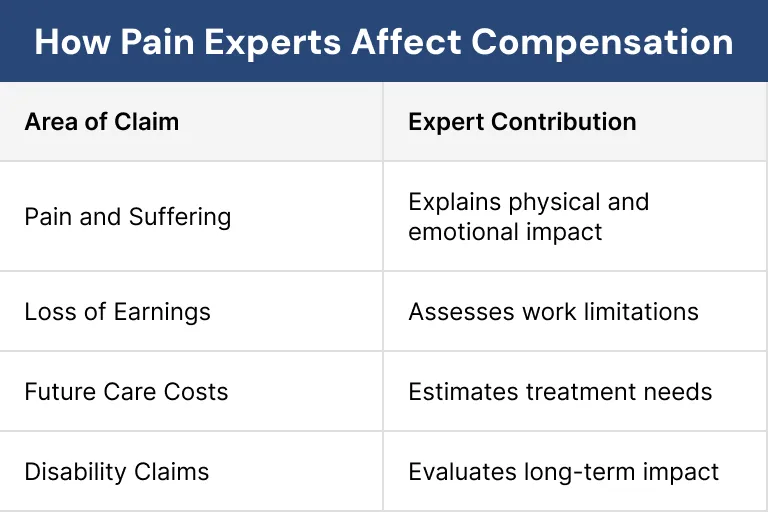
How Does Personal Injury Pain Management Affect Compensation Claims?
Pain management is vital for injury cases. It helps in proving the level of pain and its effect on a person’s life and future needs.
Let’s see how personal injury pain management affects various parts of compensation:
1. Impact On Pain And Suffering Damages
The damage from pain and suffering depends on how much that person felt physical and emotional pain. A pain expert explains the level and duration of such pain. This ensures fair compensation for the person who went through such an experience.
2. Effect On Loss Of Earnings Claims
Injuries that limit a person’s ability to do their job can lower their income. It is the task of the expert witness to check any work restrictions caused by the injuries. This helps in proving claims for loss of earnings and future income loss.
3. Role In Future Treatment And Rehabilitation Costs
Some kinds of injuries may require lifelong care or treatment. The expert will estimate what future treatments may be required. This would help plan fair costs for treatment and care.
4. Influence On Long-Term Disability Compensation
In severe cases, this pain can cause long-term disability. The expert will check if the person is capable of recovering from such effects or not. It will determine the compensation needed in the long-term.
Case Study
This 42-year-old man injured his shoulder via an equipment failure at work. The person was expected to recover from the injury in a few months. But the pain stayed and spread from his shoulder to his neck. The claimant had to stop working for two years due to pain and needed help with personal matters.
The insurance company confirmed that the injury was not fake, but it only agreed to pay out £30,000. To prove that the claim was valid, a pain management expert witness checked the medical records of the person and examined him.
These findings show that the person’s injury has made a lot of changes in his life. As a result, he got a total compensation of £390,000. This amount included loss of earnings and his suffering.
Conclusion
Pain after an injury may change a person’s life in many ways. For example, it may affect the work, sleep patterns and even the normal movement. In a claim for personal injury, proving the pain is not easy without the help of a medical expert.
A pain management expert witness looks at medical records. They give information about the link between the injury and pain and how strong it is. It also tells about the duration of the pain. This clear and simple view helps courts understand the case. It also helps in making fair compensation decisions.
At Concise Medico, we provide expert medico-legal witness services for personal injuries. If you require an expert pain management witness, feel free to contact us now.