TABLE OF CONTENT
Did you know that one in five adults aged 18-74 years had been abused as a child before the age of 16. This implies millions of individuals still experience trauma. However, most go unreported years later. Historic abuse claims can be difficult, but they must be investigated. In case you have been a victim of abuse years back, you can still seek compensation for historic abuse claims.
What is Historical Abuse?
Historical abuse involves discovering childhood abuse later in life. This is because the child was unaware of abuse at the time. It becomes painful over time. This form of abuse may occur against anybody below 18 and could be physical, emotional, or sexual. The victim might not realise how the abuse has affected them to the full extent until they grow up. Then they can either seek assistance or make historic abuse claims.
Child sexual abuse is of two main types:
- Contact abuse: This occurs when the abuser touches a child or forces a child to touch them. It involves reaching out to somebody.
- Non-contact abuse: This occurs without any bodily contact. For instance, the child can be abused with pictures, words, or the internet.
Types of Historic Abuse
Abuse is an intentional harm. It can happen at home, school, or anywhere kids and adults should be safe. Here are the main types of historic abuse:
1. Sexual Abuse
Sexual abuse occurs when someone touches or shows a child something inappropriate. A grown-up, like a teacher, coach, or leader, can do this. Never blame the child.
2. Physical Abuse
Physical violence affects a child’s body. This includes punching, kicking, and harsh punishments. This happens often in strict schools and homes.
3. Emotional Abuse
Child emotional abuse affects the mind and heart. It can be name-calling, yelling, threats, or making a child feel small or terrified. Some adults purposely humiliate or scare children.
4. Neglect
Neglect is when a child lacks basic needs. This can imply no food, care, affection, or shelter. Some institutions leave kids alone for hours.
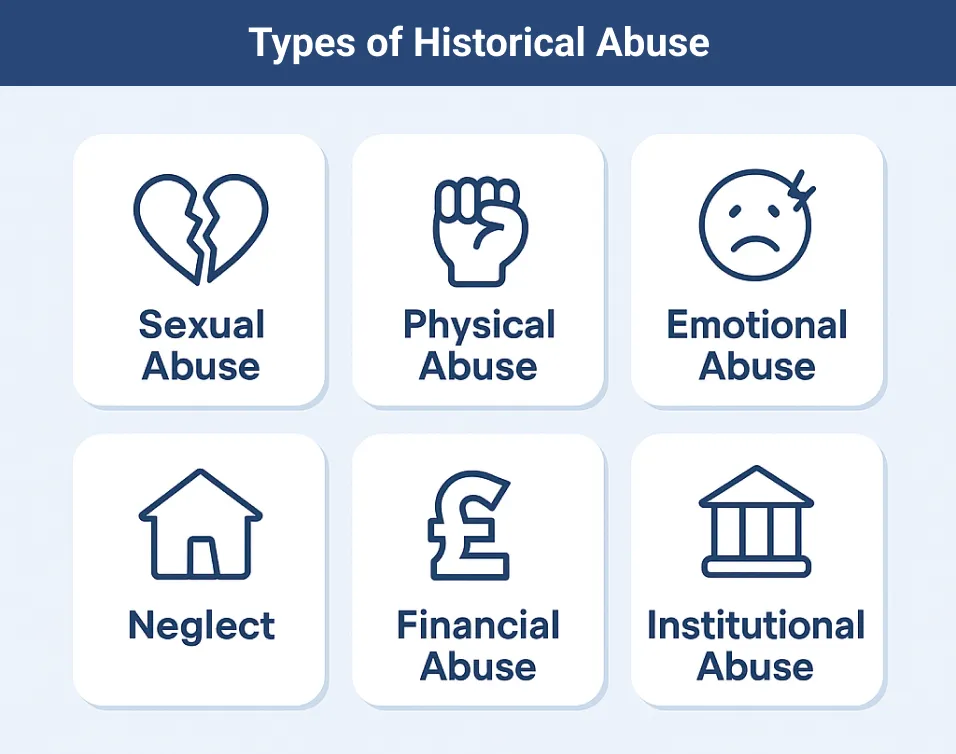
5. Financial Abuse
Financial abuse involves stealing money or property. A family member or helper can do this. They may steal money or take the child’s property.
6. Institutional Abuse
Institutions where several people live or receive care involve institutional abuse. This can be a school, care home, hospital, or orphanage. Staff of the organisation harm or neglect people.
How Can Historical Abuse Be Proven?
Historical abuse is hard to prove, but it can be done. The thing is to find evidence indicating that the abuse took place. Some of the ways of proving historic abuse claims are as follows:
- Police Crime Reference Number: If you reported the abuse to the police, you will have a crime reference number. This number shows that the crime has been reported. You can call the police and get it in case you do not have it.
- Survivor Account: Your own testimony is very important. It depends on how you remember your abuse.
- Witness Statements: Abuse witnesses can help. Friends, relatives, and past teachers may remember.
- Medical Records: If you saw a doctor for injuries, these can prove abuse. This can be done with medical reports and tests.
- Photographs and Documents: Abuse-related photos, letters, and documents are important. They can show where and when abuse occurred.
- Expert Evidence: Experts may assist in certain circumstances. They can describe how the abuse might have impacted you or others.
You need to speak to a lawyer in case you are considering making historic abuse claims. They may aid in evidence gathering. No need to do this alone.
Challenges in Investigating Historic Abuse
Here are some challenges that arise during historic abuse investigations:
- Absence of Physical Evidence: This is the major issue. Time may wipe out DNA and fingerprints. This might hinder historic abuse investigations.
- Memory Inconsistencies: Memories can fade or change over time. It can lead to different versions of events, making proof harder.
- Old Laws: Abuse may have occurred under different laws. This may make judging the case challenging.
- Victim Services: Police have highly trained officers who understand how difficult this process is for victims. Support services can help victims during investigations.
Historic abuse requires time and attention. The police can be rough, but they strive to help victims and to get them justice.
Can I Claim Compensation For Historical Abuse?
Yes, it is possible to claim compensation for historic abuse. The time may not matter unless the abuse was reported to the police. Victims of historic abuse claims receive compensation from the Criminal Injuries Compensation Authority (CICA). You must follow regulations and processes.
Steps to Claim Historical Abuse Compensation
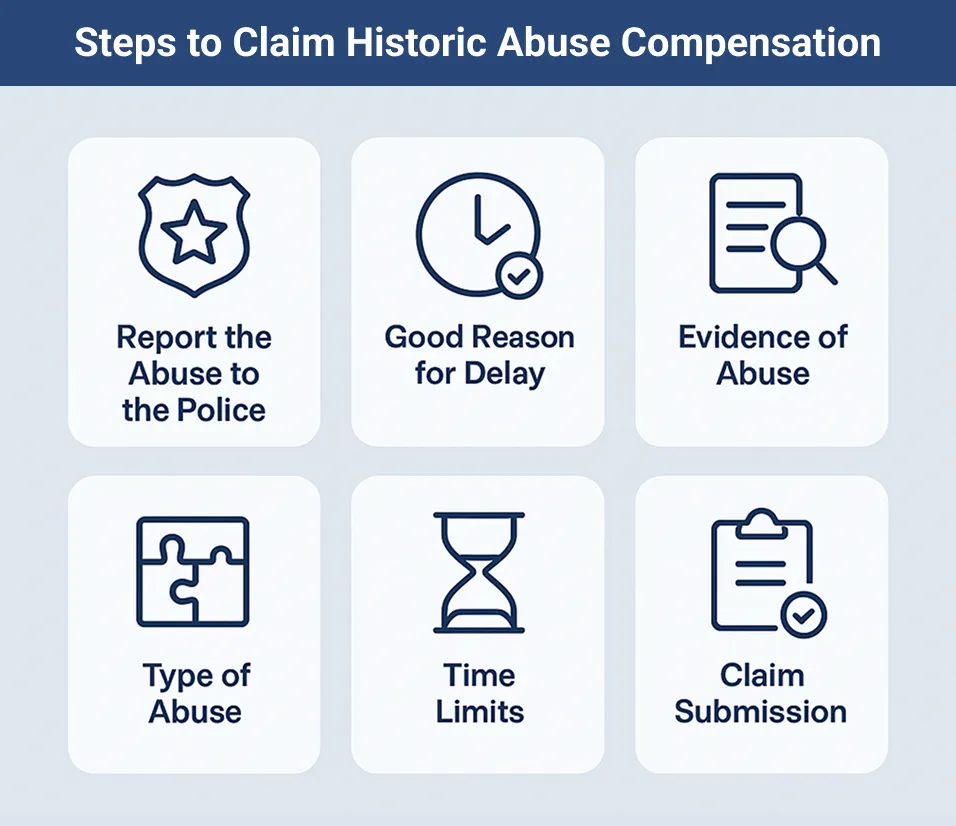
To claim historic abuse compensation, you must follow the following procedure:
- Report the Abuse to the Police: First, reach out to the police to report abuse. This is crucial to historic abuse claims. Even if it happened years back, you must report the incident to the police. The police will ensure that you are given a crime reference number when you report it.
- Good Reason for Delay: In case you were a child at the time of the abuse, you will have to state the reason for not claiming. The CICA knows that the child might not be in a position to make historic abuse claims compensation immediately. They reject explanations like not knowing or understanding the compensation structure.
- Evidence of Abuse: You must convince that you were abused. Your claim may be supported by medical records, statements by witnesses, police crime list reference numbers, and other evidence.
- Type of Abuse: CICA gets various historic abuse claims. This includes physical, sexual, emotional, neglect, and psychological abuse. You can make historic abuse claims based on the kind of abuse you’ve faced.
- Time Limits: As a rule, the historic abuse claims should be brought within two years of the abuse. If the abuse was reported to police, the CICA may grant exceptions. The regulations are complicated; therefore, consult a lawyer to understand them.
- Claim Submission: Your lawyer will submit the CICA historic abuse claims after obtaining all the data. Your claim will be reviewed by CICA. They may request more details. Finally, they will decide your eligibility and compensation depending on the nature of abuse and its impact on your life.
For further guidance, read our blog: A Guide on Making CICA Abuse Claims.
Factors Affecting the Amount of Compensation You Receive
The historic abuse claims may have varied compensations. As a rule, the litigation in sexual abuse can be between £1,000 and £44,000. The amount is determined based on a few factors, such as:
- The form and the length of the abuse.
- The type of injuries or trauma sustained (physical or mental).
- Evidence that supports what you claim.
For instance, frequent non-penetrative abuse lasting less than three years could get you £6,600. Compensation varies from £22,000 to £44,000 for severe abuse lasting more than three years. The CICA tariff system determines compensation for historic abuse claims.
Are Historic Abuse Prosecutions Successful?
Historic abuse claims and prosecutions are challenging yet possible. Several obstacles make these cases hard to prove:
- Memory Problems: Memories fade away with time, and one remembers fewer details.
- Absence of Physical Evidence: Evidence that’s several years old might become nonexistent.
Victim Credibility: The defendant can challenge the victim’s account of the abuse.
Successful Historic Abuse Claims Case Studies
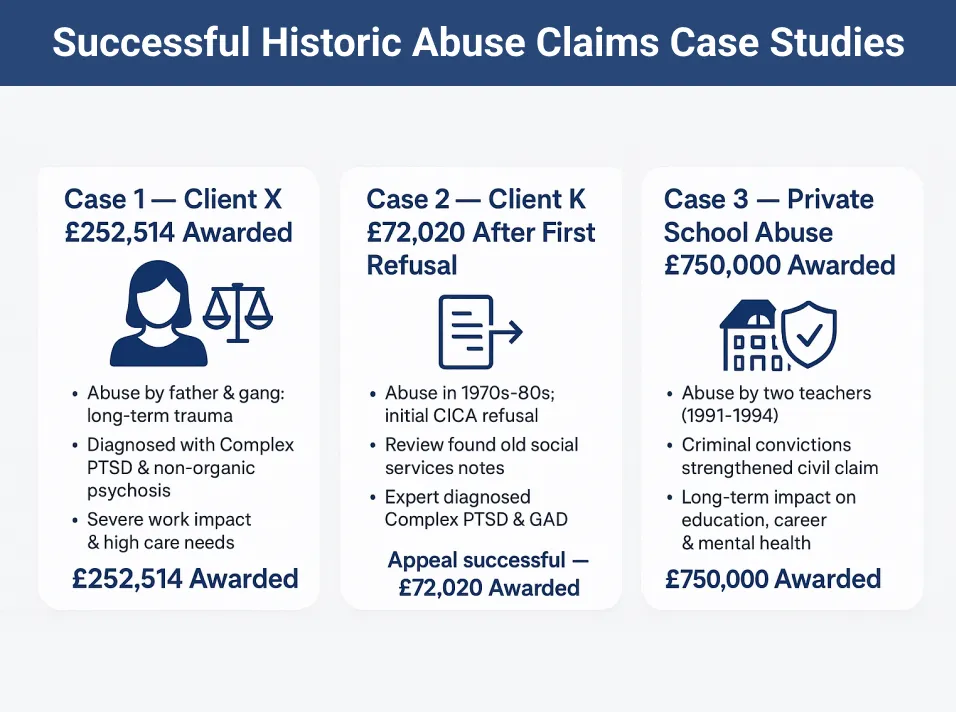
Many people live with deep hurt from abuse in the past. Some feel they will never be heard. But real cases show that help is still there. These three cases tell us that claims can win even when the abuse took place long ago. They also show how strong proof, clear records, and good legal work can lead to fair pay-outs. Here are three success stories:
Case 1: Client X (£252,514 Awarded)
Client X was a young girl when the abuse began. Her own father hurt her. Other men linked to a paedophile gang also abused her. The abuse lasted for years. As she grew older, she carried the pain with her. It harmed her mind and her life.
Years later, doctors said she had Complex PTSD. She also had non-organic psychosis. Her symptoms made work very hard. Many days she could not cope. Her health needs were high. She needed long-term care. She also lost a lot of wages because she could not work with ease.
Solicitors gathered every record they could. They took old medical notes. They got a full report from a forensic psychiatrist. This expert wrote down how the abuse had harmed her mind and her daily life. They also set out very clear proof of how much money she had lost. This included lost past wages and the wages she would lose in future. They even added costs for therapy she would need for years.
The claim went to CICA. But there were delays. CICA took a long time to act. Solicitors kept pushing. They even made a formal complaint about the slow pace. After many months, CICA accepted the claim. In January 2025, they awarded her £252,514.
This case matters a lot. It shows that a claim can win even if the abuse took place decades earlier. It also shows how important it is to have strong medical proof and clear money records. With the right help, survivors can still get justice.
Case 2: Client K (£72,020 After First Refusal)
Client K was abused by her father too. This took place in the 1970s and 1980s. That was more than forty years ago. When she first went to CICA, they said no. They said it was too late. They also said there was not enough proof.
But solicitors did not give up. The solicitors asked for a review. Reviewing old files, they searched for support records. Notes from social services and other papers were found that backed her story. She was also sent to a medical expert.
The expert checked her and said she had Complex PTSD. They also said she had Generalised Anxiety Disorder. The doctor wrote that the long delay in reporting was not her fault. Her mental health issues made it hard for her to come forward sooner. This point is very important in historic claims.
When CICA saw the new proof, they changed their mind. They agreed that there were strong reasons for the delay. They then accepted the claim and awarded £72,020.26.
This case matters because it shows that a “no” does not need to be the end. When new proof is added, or when a good expert explains the delay, the claim can still win. Many survivors fear rejection. This case shows that appeals can work.
Case 3: Private School Abuse (£750,000 Awarded)
The last case is one of the largest awards in recent years. It is about a man known as “PQR”. When he was a boy at a private school, two teachers sexually abused him. This took place between 1991 and 1994.
The teachers were later found guilty in 2017. Their conviction made the civil claim stronger. Once guilt is proven in court, it becomes easier to link the harm to the abusers and the school.
The impact on PQR was huge. The abuse changed his life path. It harmed his mind, his confidence, and his studies. It also hurt his job chances as he grew older. Switalskis showed how the abuse led to long-term loss. This included impact on his education, his mental health, and the money he could have earned.
The court awarded him £750,000 plus legal costs. This award shows how serious the loss was. It also shows that schools and other bodies can be held to account. When there is strong proof and expert reports, the amount can be high.
Conclusion
Bringing historic abuse claims to justice is difficult, but possible. Such claims are challenging due to lost memories and lost evidence. Nevertheless, victims can still succeed with the guidance of a solicitor. Given case studies prove that such abuse claims can result in a big win. All that matters is that the victims don’t give up and get the compensation they deserve.
FAQs
Did you know that one in five adults aged 18-74 years had been abused as a child before the age of 16. This implies millions of individuals still experience trauma. However, most go unreported years later. Historic abuse claims can be difficult, but they must be investigated. In case you have been a victim of abuse years back, you can still seek compensation for historic abuse claims.
What is Historical Abuse?
Historical abuse involves discovering childhood abuse later in life. This is because the child was unaware of abuse at the time. It becomes painful over time. This form of abuse may occur against anybody below 18 and could be physical, emotional, or sexual. The victim might not realise how the abuse has affected them to the full extent until they grow up. Then they can either seek assistance or make historic abuse claims.
Child sexual abuse is of two main types:
- Contact abuse: This occurs when the abuser touches a child or forces a child to touch them. It involves reaching out to somebody.
- Non-contact abuse: This occurs without any bodily contact. For instance, the child can be abused with pictures, words, or the internet.
Types of Historic Abuse
Abuse is an intentional harm. It can happen at home, school, or anywhere kids and adults should be safe. Here are the main types of historic abuse:
1. Sexual Abuse
Sexual abuse occurs when someone touches or shows a child something inappropriate. A grown-up, like a teacher, coach, or leader, can do this. Never blame the child.
2. Physical Abuse
Physical violence affects a child’s body. This includes punching, kicking, and harsh punishments. This happens often in strict schools and homes.
3. Emotional Abuse
Child emotional abuse affects the mind and heart. It can be name-calling, yelling, threats, or making a child feel small or terrified. Some adults purposely humiliate or scare children.
4. Neglect
Neglect is when a child lacks basic needs. This can imply no food, care, affection, or shelter. Some institutions leave kids alone for hours.
5. Financial Abuse
Financial abuse involves stealing money or property. A family member or helper can do this. They may steal money or take the child’s property.
6. Institutional Abuse
Institutions where several people live or receive care involve institutional abuse. This can be a school, care home, hospital, or orphanage. Staff of the organisation harm or neglect people.
How Can Historical Abuse Be Proven?
Historical abuse is hard to prove, but it can be done. The thing is to find evidence indicating that the abuse took place. Some of the ways of proving historic abuse claims are as follows:
- Police Crime Reference Number: If you reported the abuse to the police, you will have a crime reference number. This number shows that the crime has been reported. You can call the police and get it in case you do not have it.
- Survivor Account: Your own testimony is very important. It depends on how you remember your abuse.
- Witness Statements: Abuse witnesses can help. Friends, relatives, and past teachers may remember.
- Medical Records: If you saw a doctor for injuries, these can prove abuse. This can be done with medical reports and tests.
- Photographs and Documents: Abuse-related photos, letters, and documents are important. They can show where and when abuse occurred.
- Expert Evidence: Experts may assist in certain circumstances. They can describe how the abuse might have impacted you or others.
You need to speak to a lawyer in case you are considering making historic abuse claims. They may aid in evidence gathering. No need to do this alone.
Challenges in Investigating Historic Abuse
Here are some challenges that arise during historic abuse investigations:
- Absence of Physical Evidence: This is the major issue. Time may wipe out DNA and fingerprints. This might hinder historic abuse investigations.
- Memory Inconsistencies: Memories can fade or change over time. It can lead to different versions of events, making proof harder.
- Old Laws: Abuse may have occurred under different laws. This may make judging the case challenging.
- Victim Services: Police have highly trained officers who understand how difficult this process is for victims. Support services can help victims during investigations.
Historic abuse requires time and attention. The police can be rough, but they strive to help victims and to get them justice.
Can I Claim Compensation For Historical Abuse?
Yes, it is possible to claim compensation for historic abuse. The time may not matter unless the abuse was reported to the police. Victims of historic abuse claims receive compensation from the Criminal Injuries Compensation Authority (CICA). You must follow regulations and processes.
Steps to Claim Historical Abuse Compensation
To claim historic abuse compensation, you must follow the following procedure:
- Report the Abuse to the Police: First, reach out to the police to report abuse. This is crucial to historic abuse claims. Even if it happened years back, you must report the incident to the police. The police will ensure that you are given a crime reference number when you report it.
- Good Reason for Delay: In case you were a child at the time of the abuse, you will have to state the reason for not claiming. The CICA knows that the child might not be in a position to make historic abuse claims compensation immediately. They reject explanations like not knowing or understanding the compensation structure.
- Evidence of Abuse: You must convince that you were abused. Your claim may be supported by medical records, statements by witnesses, police crime list reference numbers, and other evidence.
- Type of Abuse: CICA gets various historic abuse claims. This includes physical, sexual, emotional, neglect, and psychological abuse. You can make historic abuse claims based on the kind of abuse you’ve faced.
- Time Limits: As a rule, the historic abuse claims should be brought within two years of the abuse. If the abuse was reported to police, the CICA may grant exceptions. The regulations are complicated; therefore, consult a lawyer to understand them.
- Claim Submission: Your lawyer will submit the CICA historic abuse claims after obtaining all the data. Your claim will be reviewed by CICA. They may request more details. Finally, they will decide your eligibility and compensation depending on the nature of abuse and its impact on your life.
For further guidance, read our blog: A Guide on Making CICA Abuse Claims.
Factors Affecting the Amount of Compensation You Receive
The historic abuse claims may have varied compensations. As a rule, the litigation in sexual abuse can be between £1,000 and £44,000. The amount is determined based on a few factors, such as:
- The form and the length of the abuse.
- The type of injuries or trauma sustained (physical or mental).
- Evidence that supports what you claim.
For instance, frequent non-penetrative abuse lasting less than three years could get you £6,600. Compensation varies from £22,000 to £44,000 for severe abuse lasting more than three years. The CICA tariff system determines compensation for historic abuse claims.
Are Historic Abuse Prosecutions Successful?
Historic abuse claims and prosecutions are challenging yet possible. Several obstacles make these cases hard to prove:
- Memory Problems: Memories fade away with time, and one remembers fewer details.
- Absence of Physical Evidence: Evidence that’s several years old might become nonexistent.
Victim Credibility: The defendant can challenge the victim’s account of the abuse.
Successful Historic Abuse Claims Case Studies
Many people live with deep hurt from abuse in the past. Some feel they will never be heard. But real cases show that help is still there. These three cases tell us that claims can win even when the abuse took place long ago. They also show how strong proof, clear records, and good legal work can lead to fair pay-outs. Here are three success stories:
Case 1: Client X (£252,514 Awarded)
Client X was a young girl when the abuse began. Her own father hurt her. Other men linked to a paedophile gang also abused her. The abuse lasted for years. As she grew older, she carried the pain with her. It harmed her mind and her life.
Years later, doctors said she had Complex PTSD. She also had non-organic psychosis. Her symptoms made work very hard. Many days she could not cope. Her health needs were high. She needed long-term care. She also lost a lot of wages because she could not work with ease.
Solicitors gathered every record they could. They took old medical notes. They got a full report from a forensic psychiatrist. This expert wrote down how the abuse had harmed her mind and her daily life. They also set out very clear proof of how much money she had lost. This included lost past wages and the wages she would lose in future. They even added costs for therapy she would need for years.
The claim went to CICA. But there were delays. CICA took a long time to act. Solicitors kept pushing. They even made a formal complaint about the slow pace. After many months, CICA accepted the claim. In January 2025, they awarded her £252,514.
This case matters a lot. It shows that a claim can win even if the abuse took place decades earlier. It also shows how important it is to have strong medical proof and clear money records. With the right help, survivors can still get justice.
Case 2: Client K (£72,020 After First Refusal)
Client K was abused by her father too. This took place in the 1970s and 1980s. That was more than forty years ago. When she first went to CICA, they said no. They said it was too late. They also said there was not enough proof.
But solicitors did not give up. The solicitors asked for a review. Reviewing old files, they searched for support records. Notes from social services and other papers were found that backed her story. She was also sent to a medical expert.
The expert checked her and said she had Complex PTSD. They also said she had Generalised Anxiety Disorder. The doctor wrote that the long delay in reporting was not her fault. Her mental health issues made it hard for her to come forward sooner. This point is very important in historic claims.
When CICA saw the new proof, they changed their mind. They agreed that there were strong reasons for the delay. They then accepted the claim and awarded £72,020.26.
This case matters because it shows that a “no” does not need to be the end. When new proof is added, or when a good expert explains the delay, the claim can still win. Many survivors fear rejection. This case shows that appeals can work.
Case 3: Private School Abuse (£750,000 Awarded)
The last case is one of the largest awards in recent years. It is about a man known as “PQR”. When he was a boy at a private school, two teachers sexually abused him. This took place between 1991 and 1994.
The teachers were later found guilty in 2017. Their conviction made the civil claim stronger. Once guilt is proven in court, it becomes easier to link the harm to the abusers and the school.
The impact on PQR was huge. The abuse changed his life path. It harmed his mind, his confidence, and his studies. It also hurt his job chances as he grew older. Switalskis showed how the abuse led to long-term loss. This included impact on his education, his mental health, and the money he could have earned.
The court awarded him £750,000 plus legal costs. This award shows how serious the loss was. It also shows that schools and other bodies can be held to account. When there is strong proof and expert reports, the amount can be high.
Conclusion
Bringing historic abuse claims to justice is difficult, but possible. Such claims are challenging due to lost memories and lost evidence. Nevertheless, victims can still succeed with the guidance of a solicitor. Given case studies prove that such abuse claims can result in a big win. All that matters is that the victims don’t give up and get the compensation they deserve.