TABLE OF CONTENT
- Key Takeaways
- What Is an Orthopaedic Injury Claim?
- What Can Lead to an Orthopaedic Negligence Claim?
- Who Can Make an Orthopaedic Injury Claim?
- How to Make an Orthopaedic Injury Claim in the UK?
- How Do You Prove an Orthopaedic Negligence Claim?
- What Are the Time Limits and Important Considerations?
- How to Choose the Right Solicitor for an Orthopaedic Claim
- Orthopaedic Injury Claim Case Study: Ebanks-Blake v Calder
- Conclusion
- FAQs
Understanding Orthopaedic Claims: A Guide for Patients
Did you go for orthopaedic treatment and end up with more pain than before? Orthopaedics is a medical field that treats the spine, bones, joints, muscles, tendons and ligaments. This includes things like broken bones, hip or knee replacements, injuries to ligaments and back pain.
Most treatments work well, but sometimes mistakes happen. Even a small error in orthopaedics can lead to big problems, like limited movement, needing more surgery, not being able to work or needing long-term care.
Orthopaedic negligence is also a significant concern in the UK. NHS Resolution reported that orthopaedic surgery accounted for 11.5% of clinical claims received in the last financial year. This makes it the second-highest speciality by number of claims.
That’s where orthopaedic negligence claims come in. These claims let people ask for compensation when poor care, that could have been avoided, causes harm. You can make an orthopaedic injury claim against both NHS and private healthcare providers. The process is similar in both cases.
What Is an Orthopaedic Injury Claim?
An orthopaedic injury claim is a legal claim for medical mistakes made during orthopaedic treatment. These claims can arise from care provided by the NHS or private healthcare providers. The claim is based on whether the care provided was not up to the expected standard and caused harm.
1. Claim Elements and Evidence
When you file an orthopaedic injury claim, it should meet the following key elements;
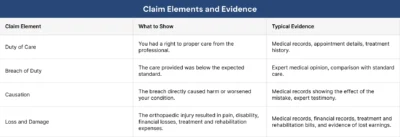
Orthopaedic injury claims involve harm that would not have occurred if no mistakes had been made. Orthopaedic injury claims can result from surgical errors, misdiagnoses and late diagnoses.
2. Common Injuries From Orthopaedic Medical Negligence
Orthopaedic medical negligence can cause several injuries. These injuries affect the musculoskeletal system. Most common injuries include soft tissue injuries, nerve damage and spinal injuries. Orthopaedic negligence can also cause joint damage, infection-related injuries and untreated or incorrectly healed bone fractures.
What Can Lead to an Orthopaedic Negligence Claim?
Orthopaedic negligence can occur at various stages of treatment. It can happen in the emergency room, at a clinic, during surgery or even after you return home. The following are the most common reasons people file orthopaedic injury claims.
1. Missed or Delayed Diagnosis
Missed or delayed diagnosis is one of the main reasons people file claims for orthopaedic injuries. Some examples include:
- X-rays missed the fracture (for example, scaphoid wrist fractures).
- Dislocation not recognised.
- Tendon rupture missed.
- Septic arthritis or infection in a joint wasn’t found early.
- Cauda equina ‘red flags’ not acted on.
2. Delayed Referral or Delayed Treatment
The diagnosis is sometimes correct, but the treatment is too slow. For example:
- Not calling an orthopaedic doctor when needed.
- Not setting up more imaging tests when symptoms don’t go away.
- Not doing surgery when it is clearly needed.
If treatment is delayed, a problem that could have been treated may become more serious. That’s why orthopaedic negligence claims generally centre on ‘what should have happened sooner’.
3. Surgical Errors
Surgery is complicated. But fundamental safety procedures are still important. Here are some examples that can lead to orthopaedic injury claims:
- Doing surgery on the wrong spot or level.
- Incorrect placement that damages nerves.
- Avoidable harm to nerves, arteries or soft tissues.
- Incorrect fixation that causes early failure.
4. Infection and Poor Post-Op Care
Even if you do everything right, you can still have an infection. The key question is whether the care met the required standard:
- Antibiotic treatment is delayed when urgent treatment is needed.
- Warning signs such as fever, increasing pain, redness or wound drainage are not acted on promptly.
- Wound care isn’t good enough.
- There is no follow-up planned or carried out.
In orthopaedics, an untreated infection can lead to osteomyelitis, which is an infection of the deep bone. It can cause many surgeries or perhaps the loss of a limb.
5. Poor Consent and Communication
Patients have the right to know about the main dangers and choices. If you were not given appropriate information about significant risks or reasonable treatment options, this may be relevant to a clinical negligence claim depending on the circumstances. For instance:
- Not being informed about the potential risk of infection following joint replacement surgery.
- Not being told about the danger of nerve damage in spine surgery.
- Not being told about options other than surgery.
- Not being told that there was a potential of having revision surgery.
Problems with consent aren’t simply about the papers. They are about the communication you have with your healthcare provider.
“All patients have the right to be involved in decisions about their treatment and care and to be supported to make informed decisions if they are able.”
General Medical Council
6. Poor Rehabilitation Planning
It’s not only about the surgery while you recover. It’s about what comes next. Claims for orthopaedic injuries might occasionally include:
- Not getting physiotherapy or getting it late.
- Plans for unsafe discharge.
- Bad pain control that makes rehab harder.
- Not giving walking aids.
- Not following up after problems.
Who Can Make an Orthopaedic Injury Claim?
Most of the time, the individual who was hurt makes the injury claim. However, someone else may be able to make an orthopaedic injury claim in certain situations. People who might file claims for orthopaedic injuries are:
- The patient (adult with capacity).
- A parent or guardian (for a child).
- A ‘litigation friend’ is someone who helps someone who can’t handle their own case.
- In some cases, family members after a death.
How to Make an Orthopaedic Injury Claim in the UK?
In England and Wales, there is a standard process for an orthopaedic injury claim. Many claims follow the Pre-Action Protocol for Clinical Dispute Resolution. Sharing knowledge early is its goal. A defendant normally has 14 days to react to key letters and 4 months to submit a detailed Letter of Response after receiving a Letter of Claim. Here is the step-by-step process of filing an orthopaedic injury claim:
Step 1: Initial Case Assessment
A medical expert reviews your case, discusses your treatment experience and explains if a claim is possible. In the initial assessment, an expert also checks the deadlines and explains how your case might be funded.
Step 2: Gathering Medical Evidence
Your solicitor collects your medical records and imaging reports. These medical proofs help in evaluating your treatment and any errors that might have occurred. They also help in evaluating whether a breach of duty has happened.
Step 3: Sending the Letter of Claim
If medical evidence supports your claim, your solicitor will send the defendant a formal letter. It sets out the treatment concerns and explains the harm you suffered. The defendant will usually have four months to review the allegations and provide a response.
Step 4: Response and Negotiation
The defendant may accept responsibility, reject the claim or make a settlement offer. Your solicitor will review their response carefully. They may then negotiate with the defendant to try to reach a fair settlement.
Step 5: Starting Court Proceedings
If the defendant rejects your claim or you cannot agree on a settlement, your solicitor may take the case to court. They will prepare the necessary documents and evidence. Many cases are settled without going to court; however, your solicitor will prepare for court if needed.
How Do You Prove an Orthopaedic Negligence Claim?
Most orthopaedic injury claims come down to three questions:
- What should have been done?
- What happened in real life?
- Was that difference harmful?
These questions help demonstrate whether the care fell below the expected standard and whether it caused you harm. The claim is usually assessed in four key steps: duty of care, breach of duty, causation, loss and damage.
What Are the Time Limits and Important Considerations?
Time constraints are quite important when it comes to claims for orthopaedic injuries. You usually have three years to file an orthopaedic negligence claim. People usually start counting from the day of the injury. You can also use the ‘date of knowledge’ approach if you find out later that your damage is due to careless treatment. Important exceptions:
- Children: The three-year limitation period generally starts when the child turns 18, giving them until their 21st birthday to bring a claim.
- Mental incapacity: Different limitation rules may apply if a person lacks the mental capacity to manage their legal affairs. The specific circumstances should be assessed before assuming that the usual three-year limit applies.
Get legal advice early because limitation rules can be complex and missing the relevant deadline may affect your ability to bring a claim. Other orthopaedic claim tips are:
- Keep a symptom diary. Record your discomfort, mobility, sleep and daily life impact.
- Keep receipts. Travel, medical, equipment and care costs. Small costs accumulate.
- Take pictures of wounds, oedema, mobility assistance and changes.
“Justice delayed is justice denied.”
William Ewart Gladstone
How to Choose the Right Solicitor for an Orthopaedic Claim
To choose the right legal support for orthopaedic claims, you must consider these factors:
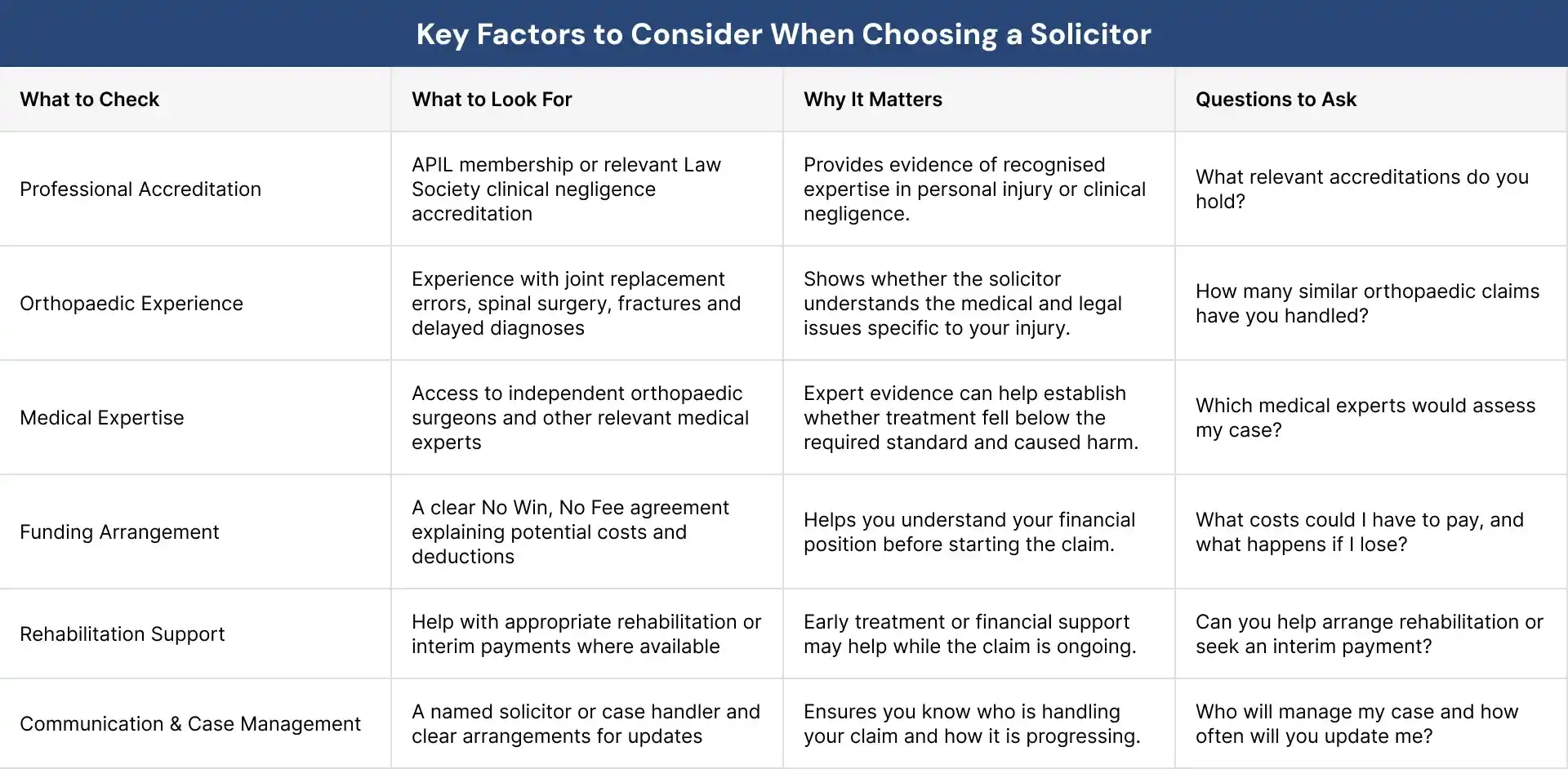
Orthopaedic Injury Claim Case Study: Ebanks-Blake v Calder
Who Was Involved?
Sylvan Ebanks-Blake (a professional footballer) and Professor James Calder (the surgeon).
What Happened?
Here’s what actually happened:
- Footballer Sylvan Ebanks-Blake broke his fibula in 2013.
- A knife was used to repair the bone, and the surgeon also performed ankle arthroscopy and microfracture.
- According to the claim, the ankle surgery was unnecessary, painful and affected his job performance.
What Did the Court Decide?
This was a divided trial; the court determined on breach of duty and causation, but not yet on final compensation. The judge found:
- The surgeon breached their duty by performing ankle arthroscopy. The correct approach would have been to repair only the fibula and monitor the ankle.
- The judge concluded that without the arthroscopy, Ebanks-Blake’s ankle would have remained pain-free for 3-5 years, allowing him to play high-level football.
- The impact on his earnings was deferred for a later trial.
What Was the Outcome?
The results were:
- Ebanks-Blake won on liability and causation.
- A quantum trial will determine the compensation he may receive.
- The judgment did not specify how much he would receive, but Reuters reported that the amount sought was about £7 million.
Conclusion
If you have suffered an injury that you believe could have been avoided, you may be able to make an orthopaedic negligence claim. Before starting your claim, consider the complexity of your case and the evidence available. If you are unsure, contact us today to connect your solicitor with experienced orthopaedic medico-legal experts who can provide the evidence needed to support your claim.